Nathan Miller, Brigadier General for Rhode Island during the Revolutionary War.
His boots were said to hold a bushel of corn apiece.
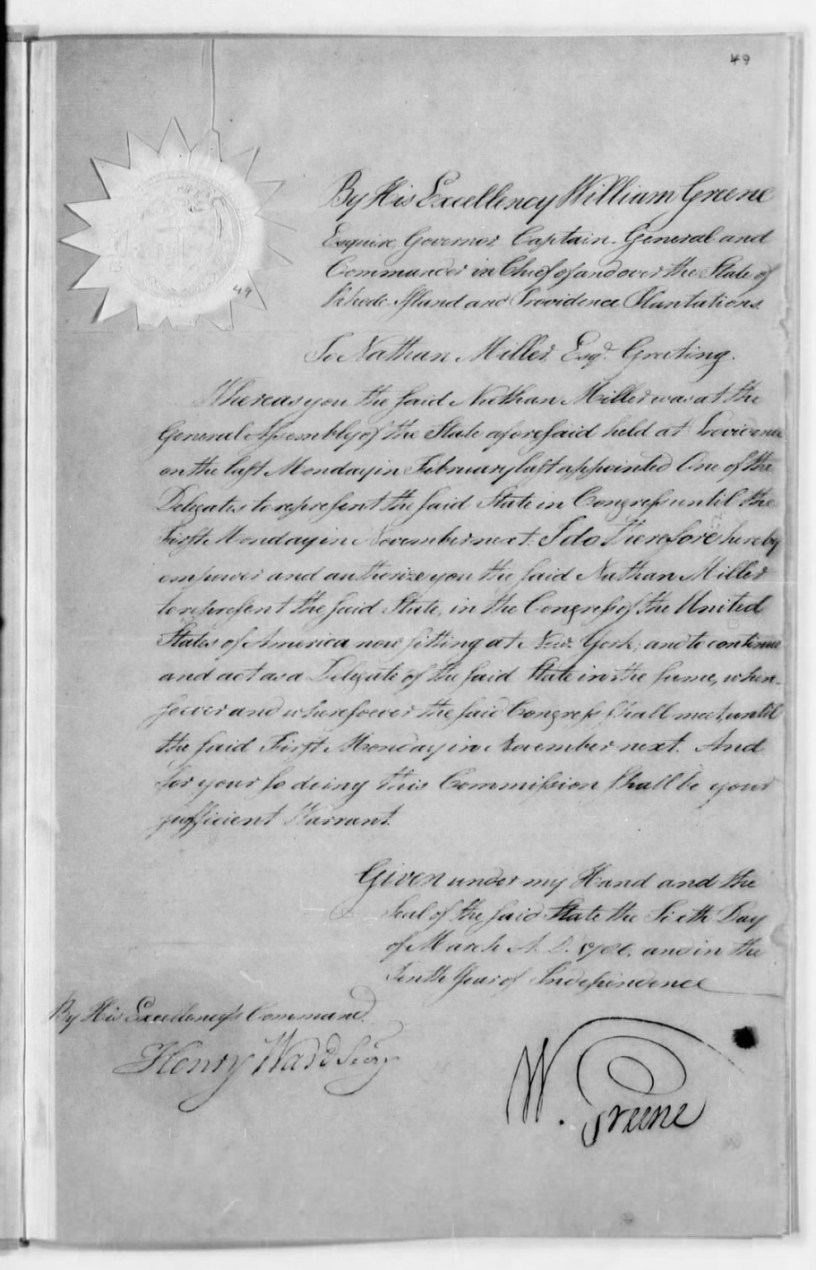
(Cover photo is the 1785 Commission to Nathan Miller as Rhode Island Delegate to Congress)
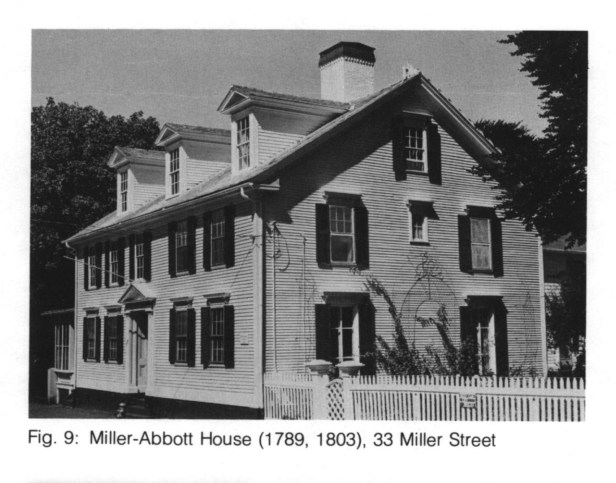
Nathan Miller was Grace Abbot’s 3rd-great grandfather. He had a home at the foot of Miller Street in Warren, Rhode Island where family lore recounts that he entertained George Washington and the French officers Lafayette and Rochambeau. In 1789 he built a new house nearby, at 33 Miller Street, which remained in the family until the 1950s and in which Grace herself grew up.
A newspaper article (presumably from Warren or Providence, RI) dated February 6, 1917 reports the founding of the General Nathan Miller Chapter of CAR (Children of the American Revolution). The article includes the following overview of his life. General Miller’s daughter Abigail, Grace’s 2nd-great grandmother, was 11 years old when the British bullet whizzed past her head as recounted in the story.
“General Nathan Miller was born in the Town of Warren, R.I. (then Swansea, MA) March 20, 1743. He was the son of Nathan and Patience (Turner) Miller, and was a descendant, on the maternal side, of Captain William Turner, the hero of the fight at Turner’s Falls which occurred during King Philip’s War. Gen. Miller was probably born in the old Miller homestead which is still standing at the foot of Miller Street in this town. It is supposed that this house was erected by his grandfather, Samuel Miller, a large landed proprietor who laid out the street now called by his name. Samuel Miller was a shipwright and many of the early Swansea vessels were built in his shipyard on the shore opposite his residence.
At the outbreak of the Revolution General Miller espoused the Patriot’s cause, and, throughout the war labored diligently in the service of his country. In 1775 he served as commissary to Gen. Hopkin’s troops. In 1777 he was appointed a recruiting officer. In 1778 he became a member of the Council of War. During the battle of Rhode Island he was in command of a regiment. In 1779, after being advanced through various military grades he was appointed Brigadier-General of the counties of Newport and Bristol. Throughout that and the following year he served on various committees. So arduous were his duties that, in 1781, he decided to withdraw from public life but, at the request of the General Assembly, reconsidered his determination and, in August of that year, was placed in command of the flag of truce “Nancy” and proceeded to New York for the purpose of negotiating an exchange of prisoners. In 1782 he was chosen one of a committee to sell estates confiscated by the State of Rhode Island and was, also, a member of the committee of ways and means. He represented Warren as a Deputy to the General Assembly of Rhode Island for a period of nine years.
With the French officers stationed in Rhode Island Gen. Miller was on the most intimate terms. Gen. Lafayette, while encamped at Windmill Hill in Warren, was his frequent guest, and a very warm friendship existed between him and Count Rochambeau and, before the Count returned to France, he and the General exchanged swords. The Rochambeau weapon is a handsome rapier, the blade ornamented with gold and blue, while the hilt and guard are of silver. It is now the property of George Lewis Cooke of Providence, a great-great-grandson of Gen. Miller. Several years ago the descendants of the French Revolutionary officers visited Rhode Island and were banqueted at the Narragansett Hotel in Providence. Mr.Cooke was one of the guests at this banquet and the rapier was examined with much interest by the French gentlemen.
On May 25, 1778, Warren was raided by 500 British and Hessian troops under command of Lieut. Col. Campbell, who stealing up the bay from Newport under cover of darkness, landed on the shore near Peck’s Rocks in Bristol and, just at daybreak, marched into Warren rousing the terrified inhabitants with their loud cries of “Huzza for King George!” The main object of their visit was the destruction of a quantity of boats and military stores at Kickemuit; and they, also, hoped to obtain possession of valuable state documents which were in the possession of Gen. Miller. At the first alarm the Gen. placed these documents in a boat and, embarking with his family, hastily crossed to the Barrington shore where a detachment of state troops were encamped and where the papers were placed in a secure hiding-place.
The personal appearance of Gen. Miller was very striking owing to his remarkable size. He was tall, and his weight exceeded 300 pounds. His boots were said to hold a bushel of corn apiece.
The British soldiers were eager to secure Gen. Miller a prisoner. They swaggered through the streets boasting that they would “get the fellow with the big boots.” They reached his residence, the old Miller homestead, just after his boat had put off from the wharf. Enraged at losing the expected prey, they fired at the craft and one of the bullets ruffled the hair of his little daughter Abigail, so close did it pass to her head.
In the excitement of the embarkation, a twelve year old slave child became so terrified that, instead of entering the boat, she slipped away and hid in the cellar of the house. Her absence was not noticed until the craft had left the shore, and it was then too late to return for her. The soldiers, rummaging the house, discovered poor Flora, who had taken refuge among the barrels of beef, pork, and cider. She was fairly dumb with fear, her eyes were rolled up until little but the whites were visible, and, as she afterward said, every bone in her body “done rattled.” Believing that she had been sent to the cellar to poison the cider stored there, the soldiers forced her to swallow a generous portion of the beverage before they would taste it. But, beyond roaring with laughter at her terror, they did not molest her and Flora, throughout her life, delighted in relating the story of her easy escape from the death which she fully expected when a burly Hessian roughly dragged her from her place of concealment.
Gen. Miller married his first cousin, Rebekah Barton, daughter of Samuel and Lilly (Turner) Barton. By this marriage there were two children, Caleb, who died unmarried at the age of 20, and Abigail who married Charles Wheaton of Providence, afterward of Warren.
The Marquis de Chastellux, who served as a Major General in the French army under Rochambeau, published at Dublin, in 1787, a narrative of his travels in America in which he describes a visit paid to Warren in November, 1780. The weather was exceedingly cold and the Marquis and his companions Mr. Lynch and M. de Montesquieu had great difficulty in crossing Bristol Ferry with their servants and horses. They hastened through Bristol to Warren and paused to bait [to feed and water] their horses at Burr’s Tavern, where they found such comfortable quarters that they decided to remain in the town overnight. After dinner the Marquis went down to the river side to inspect a sloop just in from Port au Prince. Here he met Col. Greene and General Miller and was greatly impressed with the latter’s immense size. He says “We drank tea with him in a simple but comfortable house house the inside and inhabitants of which presented a specimen of American manners.”
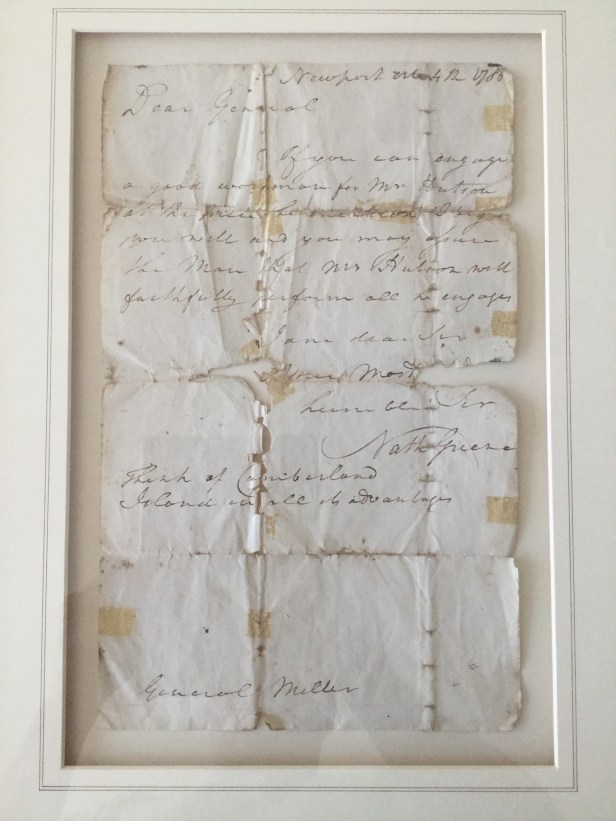
In February, 1785, Gen. Miller was elected a delegate to the Continental Congress, his colleagues being Rev. James Manning, D.D., President of Rhode Island College, now Brown University. He served one year as a member of that body.
About 1789 Gen. Miller removed from the old homestead at the foot of Miller Street to a new house higher up the street. This house is now the residence of Gen. Charles Wheaton Abbot, a great-great-grandson of Gen. Miller.
Gen. Miller died in 1790, from the effects of a cold contracted while returning in an open boat from a session of the General Assembly held at Newport. His remains are interred in the North Cemetery, at Warren, [where] the family monument bears the following inscription:
“In memory of the Hon. Nathan Miller, Esq., who Died May 20, 1790. In the 48th year of his age.”
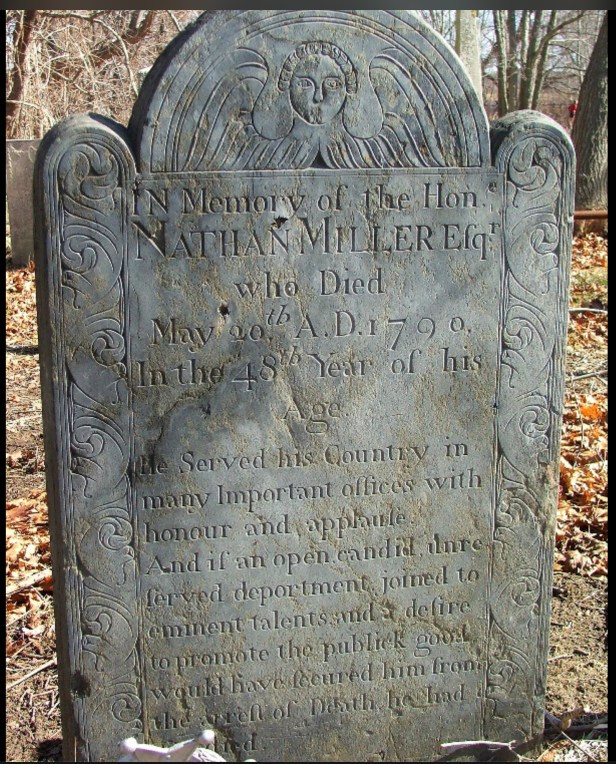
“He served his country in many important offices with honor and applause. And if an open candid unreserved deportment joined to eminent talents, and a desire to promote the public good, would have secured him from the arrest of Death he had not died.”
Of Gen. Miller a contemporary wrote, “He is the largest man in size and of the greatest abilities of any man raised in Warren.””
The author of this sketch, Miss Virginia Baker, is a great-great-grand daughter of Brigadier General Miller. In 1901 she published a fascinating brief account entitled “The History of Warren, Rhode Island, in the War of the Revolution, 1776-1783 which gives a flavor of colonial life during armed conflict. It can be read online at the following link:
 Abbot and Fletcher Family History