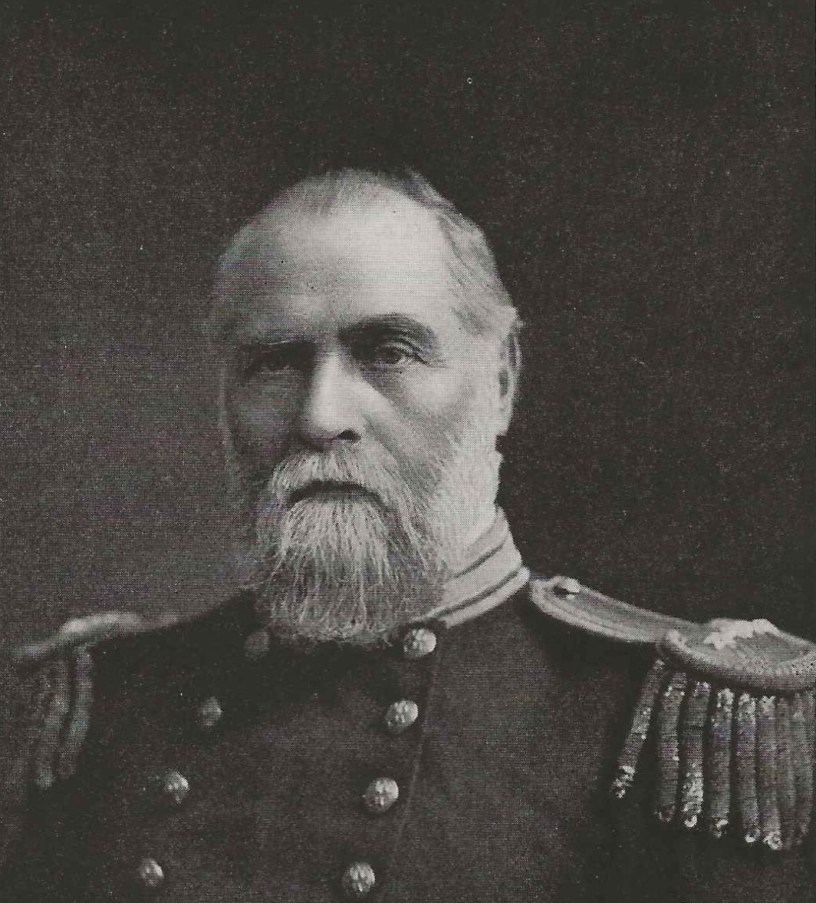
The following biographical sketch was written by Susanna Dodds Cobb, Peter Christian Asserson’s great–great grand–daughter.
Peder Kristian Asserssen was born January 5, 1839, on a small farm outside the town of Egeroy on the Norwegian coast. He was the youngest of twelve children born to Malene Rasmusdatter Midtbrod, born when she was 49 years old. His father was Asser Johannssen Helland (later, Midtbrod); he had been a teacher and had served as lieutenant in the national guard during the closing phase of the Napoleonic War before becoming a farmer. PederKristian worked as a shepherd as a boy. At sixteen he was hired as Second Assistant Engineer to build EgeroyLighthouse. He left home the same year, moving 37 miles up the coast to Stavanger, where he worked first as a shop boy; but it did not suit him. He soon signed on as cabin boy on a bark sailing out of Stavanger. After three or four years of voyaging on the North Sea and the Black Sea, to Sweden, England and Germany, he was captain of merchant ships. At age twenty he determined to cross the Atlantic Ocean to start a new life in the New World. He settled first in New York. It may have been at this time that he Anglicized his name, thus: Peter Christian Asserson (PCA).
While sailing his sloop up the coast of Norway, our cousin, Max Fletcher, discovered and contacted Assersoncousins living in Egeroy. In the summer of 2016, he and his wife Lynnie visited Bjorn and Sylvie Skadberg who kindly showed them the site of the farm and farmhouse where PCA was born. The cousins also showed Max and Lynnie the Egeroy Lighthouse on tiny Midtbrod Island, two miles from the farm where PCA was born. The rocky shore on which the lighthouse stands bears grooves that, according to local folklore, were carved by the wheels of carriages belonging to Thor, the Norse God of Thunder. Egeroy was one of the first cast iron lighthouses. PCAhelped move the 70,000 bricks that line the interior andanchor the lighthouse to the shore, but he is also credited with assisting with the engineering. Our Norwegian relatives were the first to tip me off that PCA later helped build innovative lighthouses in the U.S. as well.
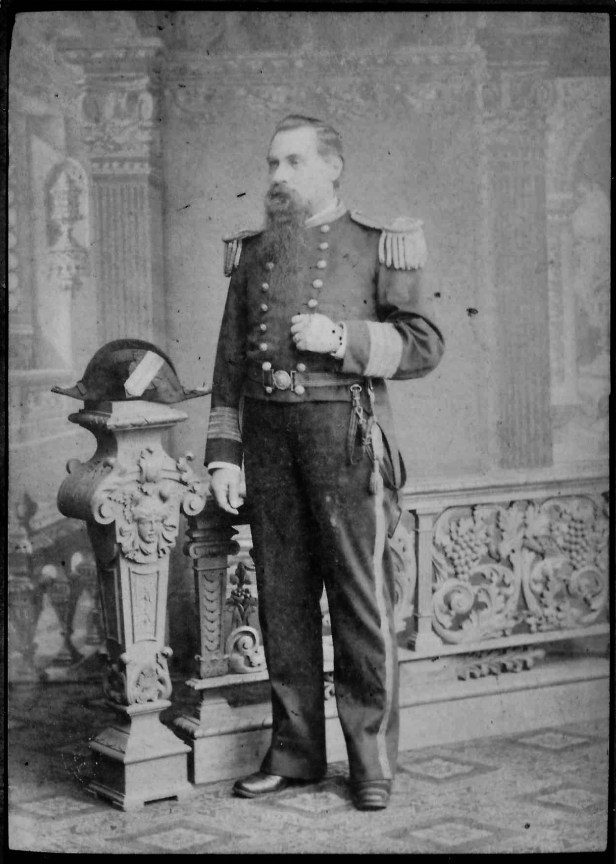
Our Norwegian cousins have kindly translated and transcribed local newspaper stories about PCA and hisremarkable mother, Malene. They shared a formal photo of him in dress uniform, taken in a photo studio in Stavanger in 1882: his mother would have been 92 years old. PCA would have been recently appointed Chief of the Virginia Navy Yard (Norfolk). In 1881 he had attained rank in the Navy for the first time (probably Lieutenant). Our cousins say he stayed with his sister Karen in Stavanger. Onesource indicates that PCA visited his homeland only once, but that he maintained close contact because of visits from Norwegian hometown seafaring men who stopped in to see him whenever they were in port. From afar, his mother certainly followed his career up through his appointment as Chief Engineer of the Brooklyn Navy Yard, since she lived to age 102 (1892). Please refer to the story of MaleneRasmussdatter Midtbrod published in Dalane Tidende on March 21, 1952, for a delightful rendition of her personal story.
PCA set down initially in New York, in the first Norwegian colony in the US. It had been established when the small sloop Restauration out of Stavanger, sponsored by Cleng Peerson, arrived at the port in 1825. It carried only 53 people, some of whom were looking for religious freedom as well as improved economic conditions. Norway was a very poor country at the time. A portion of these arrivals settled on the Manhattan East River shoreline and worked in shipping and ship building along the busy waterfront. The area where they worked and lived is now known as Two Bridges; but when PCA arrived in 1859 there would have been no bridges connecting Manhattan and Brooklyn, nor would there be for another twenty-five years.
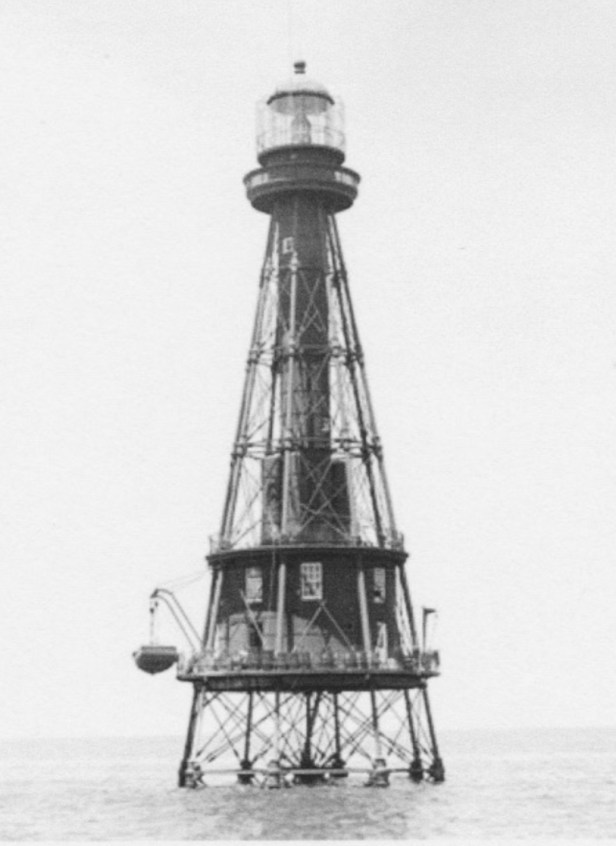
An American Society of Civil Engineers (ASCE) account of PCA’s life indicates that soon after his arrival, he obtained an appointment to the United States Coast Survey and Lighthouse Service, and that his first assignment was in the Gulf of Mexico. There heparticipated in hydrographic surveys and assisted in the erection of a screw-pile lighthouse, the “Ship Shoal Light,” fifteen miles offshore. This lighthouse was the first high-power lighthouse ever erected on a shoal in the ocean so far out from land, and the predecessor of today’s off-shore oil rigs in Gulf waters. Peder Kristian’s intention at the time was to put aside some money, then travel up the Mississippi River to join Norwegian settlements that had taken root in the Midwest following further-ranging explorations by Cleng Peerson.
However, when the American Civil War broke out on April 12, 1861, PCA faced an unexpected dilemma. Would he bend to the entreaties and example set by his friend andcolleague, Lieut. Joseph Fry and sign up to serve with the Confederacy? …… PCA made a quickly calculated offer to sail a merchant ship out of New Orleans to her consignees in Spain, necessitating a run through the Union naval blockade that was already in place in Southern waters. He was in such haste that he did not tarry to balance the aft-loaded cargo. At great risk, he delivered both crew and cargo intact– then took berth on a ship bound for New York.
Thus, PCA turned his back on the CSA and returned to New York. It was a career with the US Navy that was his goal. To equip himself for a Naval commission, heenrolled in special classes at Cooper Union, where he studied navigation, astronomy and engineering in night classes. His grammar school education in rural Norway was foundational for a cabin boy with thoughts of eventually navigating a ship, and he had already learned much aboutnavigation while voyaging at sea. However, he was keen to advance his knowledge, and would be all his life. He could not have arrived in New York at a better time, for Cooper Union had just opened its doors to immigrants and day laborers in 1859.
Cooper Union was founded by Peter Cooper, the industrialist, inventor, and entrepreneur who built “Tom Thumb,” the first American steam-powered locomotive. Peter Cooper himself had received only one year of formal education and wanted to establish a FREE institution of higher learning for immigrants and the working classes. The price of admission to Cooper Union was “willingness to learn and a commitment to excellence.” Women were admitted, and there was no color bar. PCA also took private tutoring and had the unique experience of being taught navigation by a woman, named Mrs. Thom, the widow of a sea captain whom she had assisted in navigation of his ship. He worked on farms on Long Island to defray his educational costs.
To get to Manhattan, he probably took a steam-powered ferry to cross the East River from Brooklyn. From 1814 to 1924, steam-powered ferries originated by Robert Fulton shuttled between Fulton Street in Manhattan to the terminus of today’s Fulton Street in Brooklyn. The ferries were affordable, and the ride took only five to twelve minutes. This was a notable improvement over the hour and a half that the ride had taken when the options were: rowboats, canoes, flat scows with spit sails, or flat boats propelled by horses walking on treadmills. The steam ferries were in such demand that before the bridges were built the East River was clogged with them, resulting in collisions.
PCA passed the necessary exams on May 27, 1862, a year into the Civil War, and was hired by the U.S. Navy asMaster’s Mate. In this capacity, he served on blockading duty on US ships Relief, Vixen, Patroon and Wamsutta.PCA’s initial assignments involved extending andstrengthening the very blockade that he had dodged at the onset of the war! In November of 1862 he petitioned in Brooklyn for naturalization pursuant to provisions in a July 17, 1862, Act of the U.S. Congress defining requirements, pay and entitlements of certain officers; in the same month, he was appointed from Portsmouth Virginia as Acting Ensign, the lowest ranking Navy commissioned officer, andEngineer in the U.S. Naval Marine Corps. On November 24, 1862, he was promoted to Ensign and given command of the Zouave, and later, the Cohasset, Shockokon and Berberry. In June, 1865, he was ordered to take theBerberry, an armed tugboat, from Beaufort SC to Hampton Roads VA. After this, PCA served on the USS Florida as Navigator and Division Officer. (Our Norwegian cousins indicate that PCA also earned a coastal pilots’ license in 1863.)
At the time that PCA joined the Marine Corps, it was a component of the Navy, extending the reach of the Navybeyond the shore via amphibious actions. During the Civil War, the US Naval Marine Corps’ principle missions wereto seize control of the Confederate States’ rivers and to help establish and maintain the blockade of southern ports. The intent was to prevent the Confederate States from tradingcotton and tobacco for food, clothing, and munitions, primarily with Britain, and also to prevent replenishment of southern troops by potential British sympathizers.
Our cousin, Ted Swift, found specific reference action taken by (“Acting”) “Ensign P.C. Asserson” when he served on the USS Shockokon, a large side-wheel steamer built in 1862 and fitted out as a gunboat. Ted found an official report commending PCA for his part in leading a group of 16 men armed with Enfield rifles ashore to route rebel forces that had attacked the Shockokon’s onshore pickets. This is a good example of the Marines extendingthe reach of the Navy beyond the range of a ship’s fire. This action took place July 25, 1864, on a bend in the James River deep in rebel-held territory just fifteen miles from Richmond VA, the capital of the Confederacy and its major supply center, the terminus of five rail lines.
PCA was involved in many of the important naval campaigns of the Civil War, serving under the command of a succession of Rear Admirals. He participated in coastal attacks in Georgia and South Carolina as well as attacks on Fort Fisher NC. Fort Fisher was the largest Confederate fort, manned by 2,400 troops; it protected Wilmington, NC,the main Confederate port of entry on the Atlantic Ocean, and the major hub for distribution of supplies to the Confederates generally, and to Robert E. Lee’s Army of Northern Virginia in particular.
The Second Battle of Fort Fisher was an important victory for the North late in the war. It began on January 12, 1865, with a heavy bombardment of the fort by 56 ships that lasted two and a half days. Under cover of the bombardment, 8,000 Union troops landed and took positions to attack the land face of the fort. After the bombardment, 1600 Navy sailors and 400 “Navy soldiers” ( Marines) carrying small arms commenced attack on the bastion where the land face and the sea face of the fort met. This engagement allowed the land forces to storm the land face of the fort, and soon the Confederates were engaged infighting the enemy inside as well as outside the walls of the fort.
Of particular historical note in this battle is the participation of the Ohio-based 27th U.S. Colored Infantry. This was one of the few battles of the Civil War in which black troops carried firearms. Until the Emancipation Proclamation in 1863, blacks were not welcomed into the Union Army as volunteers; once admitted, they were assigned largely to labor battalions, or to guarding wagon trains, as they did with the Army of the Potomac during the Wilderness Campaign in 1864. In the Second Battle of Fort Fisher, however, they were among the first infantry forces to take position, three days before the actual assault. They were assigned to mop-up operations, killing or capturingConfederate soldiers who escaped from the fort; they also entered into surrender negotiations. After Fort Fisher was secured, the 27th U.S. Colored Infantry participated in the capture of Wilmington itself, and then the capture and occupation of Raleigh, NC.
In August 1864, prior to the battle for Fort Fisher, Peter Christian Asserson married Mary Ann Wilson ofBrooklyn. Various documents indicate that her birthdatewas May 11, 1839; some documents indicate she was born in Manhattan and others indicate Brooklyn (King’s County). A newspaper marriage announcement stated that she was the daughter of Henry Wilson of Brooklyn; as was common in brief announcements at the time, only the father’s name was given. It has been passed down through the family that Mary Ann was adopted, and I started with the premise that Henry Wilson was her adoptive father. That premise has proven to be correct; but based on various census records I encountered originally, I concludedincorrectly that Mary Ann was adopted by a certain man named Henry Wilson, born in 1800, unmarried, who ran an orphanage in Brooklyn. I surmised he was of Scottish descent, because Wilson can be a Scottish name, and Mary Ann raised the Asserson children as Presbyterian. My error was to think that Mary Ann was referring to her birth parents when she consistently listed them in the censuses as Danish (her father) and English (her mother). In fact, she was referencing the parents who adopted her as a small child, raised her in Brooklyn, and continued to reside in Brooklyn well into her adulthood.
Mary Ann Wilson’s adoptive parents were Henry and Rebecka Wilson, born in 1813 and 1823 respectively. Census information and naturalization records suggest that they immigrated from England to NYC no later than 1841, then settled in Brooklyn in approximately 1843. Our cousin, Charley Cross, based on genealogical research done by himself and his father, has passed along the information that Mary Ann’s mother’s maiden name was Rebecka Bennett and that daughters were born to Henry and Rebecka in England before arrival in the US. The New York State 1855 Census suggests that Mary Ann Wilsonmoved with the Wilsons from Manhattan to Brooklyn in 1843, when she would have been about four years old; the implication is that she was adopted prior to that date. My hunch is that Mary Ann’s birth family was known to the Wilsons.
Henry Wilson had been born in Denmark… only belatedly did I realize that Wilson is not an uncommon Danish surname. He was naturalized on Nov. 2, 1846, in NYC (Manhattan) the place in which he would have petitioned for citizenship a minimum of five years earlier. The 1855 New York State Census indicates that Henry Wilson, age 42, lived in Brooklyn with his wife “Rebecca,” age 32, and his 17 year-old daughter, “Maria.” (This was the right age for our Mary Ann; I am assuming that Maria was the adoptive parents preferred form of “Mary.”) No older sisters appear as members of the household, but whoever they were, and whatever their histories, they would have been old enough to be married and out of the home. Henry’s occupation was “Painter.” In the 1870 USCensus Henry was a “Paint Dealer” living in Williamsburg,living with his wife Rebecca, no children in the home. Henry died at some point after that date and Rebecca lived in Brooklyn until at least 1881, when she was listed as his widow, living at 224 Division Street. All this makes Mary Ann’s adoptive parents witness to Mary Ann’s marriage and the birth of the couple’s first child in Brooklyn. Rebecca may even have been alive when Mary Ann and PCA returned to Brooklyn from Virginia in 1885, and PCA took over as Chief Engineer of the Brooklyn Navy Yard.
While I have been able to put together a glimpse of Mary Ann Wilson’s life growing up in Brooklyn with her adoptive parents, her natural parentage remains a mystery. Our best clue is the surname “MacGowan” written on Cousin Abbott Fletcher’s genealogical fan chart. So we have: Mary Ann or Maria MacGowan; born May 11, 1839,probably in Manhattan. Mary Ann’s granddaughter, our Aunt Louisa Fletcher used to say that she was Scottish on her mother’s side, and the name MacGowan would account for that. The fact that Mary Ann and PCA raised their children Presbyterian also fits in with Scottish heritage. We don’t know what religion the Wilsons practiced, but there is a long legal tradition in New York State that the birthright religion of an adopted child must be preserved and respected.
After marrying, PCA and Mary Ann were boarders in the home of a young couple in Brooklyn. At the time of theJune 12, 1865, NY State Census, Civil War had ended, they were both 26 years old, and Mary Ann was in the finalstage of her first pregnancy. PCA is listed as “Seaman,” working for the US Navy. His birthplace is listed as Norway, hers as Kings County. The surprising bit of information in this census was that PCA gave his name as “Christopher Asserson”! It is intriguing to speculate about the extent to which he made use of this name throughout the Civil War and his adult life. Perhaps he always went by the nickname “Chris,” short-form of his middle name, and chose to Anglicize it as Christopher when he assimilatedinto American life. In the Naval records we have seen, he is referred to as “P.C. Asserson.”
On June 29, 1865, a few months after the end of the American Civil War, Mary Ann gave birth to the couple’s first child, Malene Rebekah Asserson, who is the direct forebear of me and my brother and all the Fletcher cousins. She was named, as was the widespread custom for first daughters in those days, to honor first the father’s mother (Malene), and second the mother’s mother (Rebecca). I have usually seen our ancestor’s middle name spelled “Rebekah.” As it turns out, this spelling is close to the English form of the name at that time: Rebekka. Mary Ann’s adoptive mother appears to have spelled her name “Rebecka” in some documentation.
After the Civil War, PCA remained employed by the Navy. From March 1866 to 1868, he was assigned duty at the Norfolk Navy Yard in Portsmouth, Virginia. He moved there with his wife and infant daughter, and his first son, Henry Raymond, was born there in 1867, taking his first name from Mary Ann’s adoptive father. Post-war, the Yard was in shambles. “The machine shops and office buildings had been burned to the ground, the dry dock blown up and the gates and caissons destroyed” (from the ASCE memoir).
When Virginia seceded from the Union in 1861, the Union abandoned the Norfolk Navy Yard and burned it to the ground before leaving; the Union also sank its own ships to prevent their falling into enemy hands. Washington D.C. was at risk of capture at the beginning of the war, and there was insufficient manpower to operate the ships. The Confederates nonetheless took possession of a tremendous amount of war material, enabling them to buildan iron clad ship christened the CSS Virginia but known as the Merrimack to Union forces, since it was built atop the burnt-out hulk of the USS Merrimack. On March 8, 1862, the CSS Virginia attacked the USS Monitor, a Union iron-clad ship engaged in the blockade of Virginia’s coast. The USS Monitor was built at the Continental Ironworks in Brooklyn and outfitted at the Brooklyn Navy Yard. This was the first-ever duel between two iron-clad warships, and the most important naval battle of the Civil War. It remained the bloodiest single naval encounter for the United States (counting casualties on both sides) until Pearl Harbor at the start of WWII in 1941. The result of the battlewas inconclusive. However, two months later, the Confederates were forced to abandon the Norfolk Navy Yard, which they in their turn burned to the ground. The Norfolk Navy Yard remained in Union hands until the end of the war but was a desolate place.
An important part of re-building the US Navy in the wake of the Civil War was re-building the Norfolk Navy Yard. PCA played a central role in reclaiming the Yard. To inspect dry dock footings and to reconnoiter underwater wrecks for potential salvage, PCA cut a memorable figure when he donned a diving suit of the type that was developed in the seventeenth century for salvaging golden treasure from sunken galleons. He must have had tremendous strength to maneuver in one of those suits, foron land, they weighed two hundred pounds. He successfully raised two frigates, four battleships, and other river craft; he is credited with “in so doing performing some of the most difficult feats known to maritime engineering.” He is known for raising the famous gunboat Merrimack, the U.S.S. Pennsylvania, the Columbia and the Raritan.
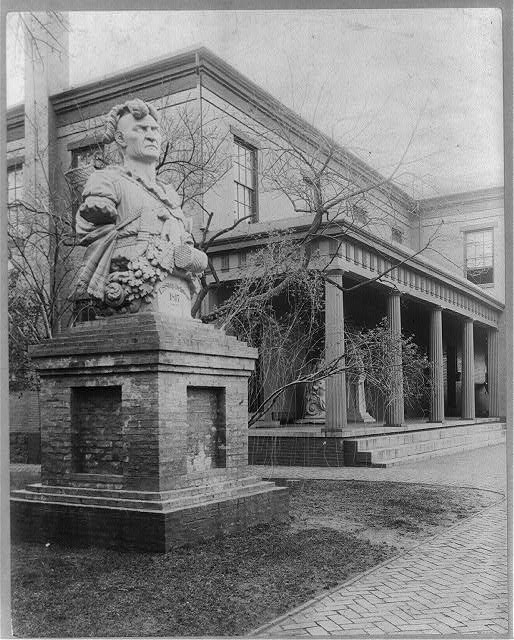
His best-remembered salvage occurred in 1866, when he pulled the U.S.S. Delaware from the depths with her figurehead intact. The USS Delaware was one of its own ships that the Union sank at the outbreak of the Civil War to prevent its capture by the Confederacy. PCA and his team detached the wooden carving from the ship’s bow in 1868 and in the early 70’s presented it to the Naval Academy in Annapolis, where it was placed upon a wooden pedestal. Carved in 1817 by William Luke, the figure was originally called “Tamanend, Chief of the Delaware Indians,” but over time cadets dubbed it “Tecumseh.” Tamanend had been a peaceful ally of Quaker William Penn’s, and the story is that cadets preferred to confront a more warlike figure, choosing Tecumseh because he had been a Shawnee warrior chief and British ally during the War of 1812. Tecumseh became part of traditional life of the Naval Academy. Known as “the god of 2.5,” the passing grade at the Academy, midshipmen tossed pennies toward it for good luck on exams. Midshipmen still observe the ritual, tossing pennies toward a bronze cast of the original figurehead, while the original itself is on permanent view in the Naval Academy Museum.
In 1868, PCA was assigned to Coast Survey duty in command of the Hasler. In March 1869, he was honorably discharged from service as a volunteer officer; at the same time, thousands of other volunteers were discharged from the Navy, their services no longer needed after the long and bloody conflict. For the next two years, PCA continued,working as a civilian “Wrecker” to clear the Elizabeth, James, Rappahannock and Potomac Rivers of obstructions and wrecks left by the war.
The year that PCA was discharged, his second daughter,Anna Gertrude was born. The family moved from Virginiato Catonsville, Maryland (outside Baltimore), and Mary Alice was born there (1871). At times PCA took lodgings away from his family in a boarding house near Portsmouth VA to be closer to his work at the Norfolk Naval Yard. My speculation is that the move to Catonsville was strategic to allow PCA to pursue his education at the same time he worked to support his family. Perhaps he attended the original University of Maryland in Baltimore. It is also possible that the direct train route to New York made intermittent coursework at Cooper Union accessible.
It appears that he maintained contacts in Brooklyn during this time: on June 22, 1871, citing his address as 92 South 2nd Street in Brooklyn (possibly his father-in-law’s address?) Peter Christian Asserson became a naturalized citizen of the United States– in the same court district in which he would have declared his intention to do so at the beginning of the Civil War. In becoming a U.S. citizen, he had to “renounce and abjure” his allegiance to the King of—Sweden! Norway did not have its own king for a stretch of five hundred years before it became an independent constitutional monarchy in 1905, when its Union with Sweden was peacefully dissolved, an example oft cited as a peaceable resolution of conflict.
After the Civil War, the Norwegian community burgeoned in both New York and the Midwest, the result of the first mass migration of Norwegians to the United States. Over 100,000 Norwegians arrived. Most of them migrated to the Midwest, where the frontier was opening up for farming under the Homestead Act and the Railroad Acts signed by President Lincoln during the war. However, some Norwegians remained in New York close to the dockyards. During the 1870’s, ships were transitioning from sail to steam, and the shipbuilding center of New York transitioned gradually from the East River waterfront of Manhattan to Brooklyn; the Norwegian community migrated across the East River to its first Brooklyn settlement in “Old South Brooklyn,” near the shipping activity in Red Hook. This is the area that corresponds best to the area known as Cobble Hill today.
In April 1873 PCA was appointed Superintendent of Improvements at the Norfolk Navy Yard and Assistant in charge of the reconstruction work of the yard based on his expertise in refitting ships and building dry docks. He re-entered with the Navy not the Marines for indeed the importance of the Marines declined for several decades after the Civil War, during the transition of ships from sail to steam power which put into question the role of Marines on board Naval ships.
After his appointment, his family returned to Portsmouth VA from Catonsville MD, and the births of Edith Rose (1874), William Christian (1875), Agnes Christabel (1876), and Frederick Asser (1879), followed. Edith Rose died at age 6, and was buried in the Cedar Grove Cemetery in Portsmouth VA.
In March 1874, five years after being discharged from the Navy as a Marine, Peter Christian Asserson passed examinations that allowed him to be commissioned as:Civil Engineer with the US Navy. One of the RADMs under whom he had served during the war was instrumental in securing his appointment to the Navy Corps of Civil Engineers which had been founded by seven civil engineers with the Navy soon after the Civil War, in 1867. On joining the Navy Corps of Engineers, PCA was given a professional title, not a rank. After 1870, civil engineers working with the Navy had been officially appointed by the President, listed in the Navy Register and paid as commissioned officers; they were regarded as commissioned officers and were paid out of military personnel appropriations. But they lacked rank. Rank was a jealously guarded prerogative of line officers in the US Navy (men with general military combat duties, not specialty duties such as the engineer or medical corps). Effective 1871, the US President (at that time, Grant) was authorized to “fix relative rank” for Civil Engineers but one POTUS after another failed to do so until 1881.
After receiving his commission with the Navy, PCA “was at once put in full charge of the reconstruction work already under way at the Norfolk Yard, and within a period of ten years this station was practically transformed……. He wrought nothing short of a miracle, transforming the mined yards into an efficient station.” (from the ASCE memoir). Hiswork included wet docks, dry docks and quays. He introduced an innovative salt water sprinkler system for safety, the first in this nation. During the decades following the Civil War, the US Navy modernized as it rose from the ashes, increasingly building ships of steel. In 1880 PCA was appointed Chief Engineer of the Norfolk Navy Yard, a title that reflected the scope of his responsibilities, buthad no rank.
A year after PCA’s appointment as the Chief Engineer of the Norfolk Navy Yard, President Arthur, who is generally credited with rebirth of the US Navy during his term (1881-85), at last fixed “relative rank” on the civil engineers of the Navy. In so doing he recognized a new staff corps within the Navy (the Corps of Civil Engineers). In 1881 “Relative rank” was fixed on exactly ten civil engineers in the Navy. The relative rank of Captain was conferred upon Wm. P.S. Sanger, who was posted at the Bureau of Yards and Docks in Washington DC and was one of the seven men who founded the Navy Corps of Engineers in 1867. Despite the honor, a military officer higher in rank than Sanger headed the Bureau.
The remaining nine men upon whom relative rank was fixed were each the chief engineer of nine different Navy Yards spread across the country. Going down the ranks, I assume that the “relative ranks” of “Commander” (2 men) and “Lt. Commander” (3 men) were applied to others of the original seven founding members of the Corps. The relative rank of “Lieutenant” was fixed on four men, one of whom must have been PCA as Chief Engineer at Norfolk Navy Yard. This small and widely dispersed group did not command much influence in Congress or the Navy. Nonetheless, almost as soon as they received relative rank, this small cadre began to agitate for granting “the prerogatives of rank and promotion” of engineering officers on the par with military officers, a practice that was already established in the US Army. Because of his forthright role in what became a protracted campaign, the Navy Corps of Engineers has credited PCA with helping to finalize theestablishment of the Civil Engineering Corps of the US Navy (per his ASCE memoir cited below).
One prerogative and outward sign of rank that had been denied members of the Navy Corps of Engineers prior to 1881 was uniform. When the ten engineers were fixed with relative rank, they were also fitted with the first ten US Navy Corps of Engineers uniforms, with a newly designed insignia. Knowing this brings into focus the significance of the formal photograph that PCA had taken of himself in the Stavanger photo studio during his 1882 visit to his mother and siblings in Norway. What pride he must have conveyed to his family and homeland!
Based on his achievements in at the Norfolk Navy Yard, PCA was appointed Chief Engineer of the Brooklyn Navy Yard in 1885. The family moved from Virginia back to Brooklyn with their seven children, ranging in age from 6 to 20. During the decade of their absence, the Norwegian community in Brooklyn had grown substantially. In 1880, there had been a second mass migration from Norway because of a severe economic depression caused by the transition from sail to steam in the shipping industry. Many sailors jumped ship and settled near the dockyards in the Red Hook area, looking to translate their shipbuilding skills from wood to steel. In the 1880s and ‘90s, there was a small but thriving community of several thousand Norwegians in Brooklyn. In 1883, the Brooklyn Bridge had been completed, beginning the development of Brooklyn as a “bedroom” community for Manhattan for many ethnic groups in addition to the Norwegians, who had high visibility in those years.
The Norwegian American Seaman’s Association promulgated Leif Ericson Day on the basis that theircountryman, not the Italian Christopher Columbus, was the first to discover America. In 1002 AD, the Vikings had not been motivated to find a passageway to anywhere, but rather to find spoils, in which pursuit they were sorely disappointed; they did not form colonies, and rarely ventured to the Americas again. Undeterred, the Brooklyn Norwegians observed September 29th as the day that Leif Ericson stepped ashore somewhere near Boston harbor in 1002. The Brooklyn Daily Eagle of September 5, 1891, describes the anniversary festivities as a Parade followed by a Banquet and a Ball. The parade route described roughly the layout of the Norwegian neighborhood: starting at the foot of Van Brunt Street, considered the heart of the Norwegian community, then marching along Van Brunt to Hamilton Avenue to Columbia Street to Union Street to Court Street to City Hall, where they were reviewed by the Mayor and Aldermen, thence to Fulton, to Smith to Sangerband Hall at Smith and Schermerhorn Streets. Prominent Norwegians were to speak at the banquet: Professor Anderson, a former US Ambassador to Denmark under the Cleveland administration; Professor Hosford of Boston, and “Lieutenant Asserson” of the Brooklyn Navy Yard. In addition to his involvement with the Norwegian American Seaman’s Association and the American Society of Engineers, (ASCE), PCA was an active participant in several civic organizations, including the Free Masons, the Knights Templar, and the Loyal Legion.
At the Brooklyn Navy Yard PCA specialized in building and rehabilitating dry docks. When he arrived at the station it was reportedly to be “practically without a dry dock or a wharf where a ship could be tied up.” (from the ASCE memoir). He introduced many innovations to the Yard for which he was greatly admired. These included space-saving designs of cranes and sea walls, and the pioneering salt-water sprinkler system. He utilized concrete in sea walls and dry dock walls and introduced an underground electric pumping station in Dry Dock # 1, at the time the only one of its kind on record. PCA was considered an authority on building dry docks and was a consultant on almost every Navy Yard in the country. Please refer to the ASCE 1932 Transaction memoir of PCA for further fascinating details of his many professional engineering achievements. PCA was credited with service in theSpanish American War (1898) from which the United States emerged victorious as a world power.
From his flight from the Confederacy to his stance on the issue of rank and promotion, PCA was known for his willingness to fight for what he thought was right. He was instrumental in a successful campaign to break down Navy precedent that allowed only military line officers to be head officer at the Washington Bureau of Yards and Docks. He and others argued that only an engineer should hold thatposition. His viewpoint prevailed, and in 1898 he himself was slated for the post but turned it down in 1899 on principle: the position had a four-year term and he was to retire in two years.
His seventeen-year campaign to have civil engineering officers receive rank on a par with military officers in the Navy bore fruit on March 3, 1899, when the Navy dropped its policy of assigning “relative rank” to civil engineering officers. This may have been in recognition that rebuilding the US Navy Yards in the years following the Civil War went hand in hand the growth of the US Navy, which had much to do with the US victory in the Spanish American War. My surmise, based on the ASCE account that he received a promotion around this time, is that it was thenthat PCA received the military rank of “Captain” (one rank below RADM).
Prior to this, all of PCA’s promotions would have been ones of “relative rank.” This is probably the basis for the well-founded family lore that while there was no question about the significance of his accomplishments or thelegitimacy of his professional titles, there was controversy surrounding his advancement through the ranks. In the public records I encountered, there were inconsistencies regarding PCA’s rank. For instance, according to the ASCE memoir, PCA was promoted to “Captain” in 1882, soon after his appointment as Chief Engineer at the Norfolk Navy Yard. If so, he would have skipped over two lower ranks in just a year. After his move to the Brooklyn Navy Yard, some newspaper accounts refer to him as Captain and others as Lieutenant (as in the Leif Ericson Day parade story). I found no references to him bearing the intervening ranks of Lt. Commander or Commander. However, cousin Ted Swift found firm evidence that following his advancement to Captain in 1899, the military rank of Rear Admiral was conferred upon him in 1901 “P.U.R.” (Promoted Upon Retirement”).
The U.S. Census of 1900 gives an interesting snapshot of the Asserson family at home in Brooklyn around the time of PCA’s retirement. In addition to “Peter C. Asserson”(head of household) there were:
*Mary Ann Wilson Asserson: wife, age 61, married 36 years, mother of 8 children, 7 living;
**Anna Spicer: daughter, age 30, married 9 years, mother of 2 children, 2 living;
***Rolf Spicer: grandson, age 7; born NY, his father born West Indies;
***Donald Spicer: grandson, age 2; also born NY (same birthplace for father);
**Mary A. Asserson: daughter, age 28, medical student;
**Agnes “S.” (sic) Asserson: daughter, age 23, living at home;
**Frederick A. Asserson: son, age 21, doctor;
****Rose Carter, age 20, cook, black, born in Virginia;
****Cornelia Jackson, age 19: servant, black, born in Virginia.
Further-ranging Census research reveals that by 1900, three children were established outside of the home:
**eldest son Henry: age 33, civil engineer, married and the father of four, living in
Brooklyn and working as Chief Sewer Engineer in that borough;
**eldest daughter Malene: age 35, married, expecting her fourth child in Lynn, MA;
**son William Christian: age 26, single at the time, a Naval officer who had already seen command: during the Spanish American War in San Juan and Cuba; in the Philippine Insurrection (aboard the USS Mindoro), and the China Relief Expedition during the Boxer Rebellion (aboard the USS Monocacy).
PCA officially retired at age 62 in 1901 as mandated; buthe continued on active duty at the Brooklyn Navy Yard for another two years because the Navy still needed his expertise. He was retained as Rear Admiral in an advisory capacity at three quarters (of a Rear Admiral’s) pay in order to continue work on the dry docks projects at the Navy Yard. After two years as a consultant, he stopped work at his own request due to a heart ailment.
When he died on December 6, 1906, most of his life’s work had been accomplished: Dry Docks #’s 1 and 2, the refitting of which he had supervised, and Dry Dock #3, the construction of which he had directed, were finished; and Dry Dock #4, which contained many features proposed by him, was nearly complete. And importantly, the struggle to achieve the “prerogatives of rank and promotion” for Navy Engineer Corps staff had been won.
RADM Peter Christian Asserson died at home, 495 Eighth Street in Brooklyn of angina pectoris, age 67. On hearing of his sudden death, his children gathered from near and far. Lieutenant William C. Asserson came from his post on board the USS Tacoma at Hampton Roads, VA; Malene Fletcher arrived from New London, CT; Agnes Swift arrived from Pittsburgh; Nancy Spicer arrived from Lexington, MA; and Dr. Mary Alice Asserson arrived from nearby Manhattan. When PCA died, his wife Mary Ann and his son Col. Henry R. Asserson of Brooklyn. Only the youngest, Dr. Frederick Asserson, was unable to attend the funeral, as he was stationed on board the battleship Columbia in Havana Harbor. RADM Robert Peary, the Arctic explorer, attended PCA’s funeral service.
When Peter Christian Asserson died, his personal property was valued at “less than $10,000” (approx..$300,000 in 2019); but his legacy was far richer than that. His legacy shines through the remarkable story of his own life and through the lives of his children and grandchildren. This immigrant from Norway and his orphan wife raised seven children who in turn contributed richly to society.The Brooklyn Daily Eagle ran an article in the November 25, 1917 edition regarding the remarkable level of military service of the family of “the late Rear Admiral Peter C. Asserson.” who was “well known in Brooklyn.” At that point in WWI, they cited twelve members of the family serving in the military: all three of his sons, two sons-in-law, six grandsons and one granddaughter (Ruth). In fact, his daughter Dr. Mary Alice Asserson was also “over there,” providing medical care. More details regarding the contributions of his progeny are noted in the following brief summaries of their lives (in birth order).
SEVEN CHILDREN and THEIR DESCENDANTS
Eldest child, Malene Rebekah Asserson (b. 1865 in Brooklyn) married William Bartlett Fletcher, who became Rear Admiral in the Navy; all three of their sons (John Asserson Fletcher, Paul Williams Fletcher, and William B. Fletcher, Jr.), were career Naval officers after graduating from the Naval Academy. Their daughter, Mary Louisa Fletcher (“Aunt Louisa”)(1895-1980) is well remembered by my generation for her devoted care of her father, “the Admiral.”
Malene, provided a home for her extended family in times of need: her sister Nancy and her sons Rolf and Donald (ca. 1900); her mother Mary Ann (1906-1911) and sister Mary Alice (ca. 1906 and 1910); and her nephews Justin and Garfield Swift. She and Wm. B. took Justin and Garfield into their home when (Malene’s sister) Agnes Christabel died giving birth to Garfield. Justin died in toddlerhood, but Garfield lived on with Malene and Wm. B. from infancy until age fifteen, when Malene died of cancer (1923).
Malene died four months after the tragic death of her eldest child, Lt. Cdr. John Asserson Fletcher (1890-1923); he was crushed to death while inspecting a cargo hold on board the ship of which he was command in Port au Prince harbor. He had married Faith Sanford Spear and adopted her two daughters by her first marriage: Antoinette and Faith. Together they had one daughter, MaleneAsserson Fletcher (1921-1997), who became the mother of myself and my brother Matthew Sanford Dodds.Matthew and his wife gave Malene as the middle name to his daughter, Sabrina.
Malene’s second son, Cdr. Paul Williams Fletcher (1892-1940) married Grace Abbot by whom he had six children: Joan Fletcher (1919-1976); Abbot Fletcher (1922-1999); Mary Alice Fletcher (1924-2011); Lieutenant JohnAsserson Fletcher II (1926-1953), Kristin Fletcher (1931-present); and Priscilla Fletcher (1931-2005). When my grandfather John Asserson Fletcher was killed in 1923, Paul and Grace provided a haven for my grandmother, my mother (age eighteen months) and my aunts (ages 7 and 8)in Newport RI where Paul was stationed at the time. Uncle Paul named his second son after his deceased brother, my grandfather, John Asserson Fletcher.
All of Paul and Grace’s children had children who were familiar to my mother and her sisters. Of these cousins, I was familiar only with Abbot and his family, that is: his wife Eileen and their three children, Judy, Max and Kristin.A summary of Paul’s grandchildren follows: Joan Fletcher Fletcher, mother of Peter, Roxanne and Paul Fletcher; Mary Alice Fletcher Chase, mother of Mary B. and Rodman Chase; Lieutenant John Asserson Fletcher, father of Melissa Fletcher; Kristin Fletcher Brock Frazier, mother of Rebecca, Jono and Fletcher Brock and Kristin Frazier; Priscilla W. Fletcher Allis, mother of John Allis and Aura Lee Allis.
Malene’s youngest son, RADM William B. Fletcher Jr. (1900-1980) “Uncle Bill” married Louise Littlepage (1904-1963); their only child, Cdr. William Bartlett Fletcher III (“Cousin Bill,” “Little Bill”)(1932-1991) married twice but had no children. My mother loved our family visits to Washington DC when we stayed with UncleBill, Louise Littlepage and Little Bill because Louise made everything into a party. After Louise died, Uncle Bill married Geraldine (AKA “Gerry”– also “Honey”) and the couple had a close bond with Garfield Swift and his wife in Maryland. Uncle Bill, Cousin Bill and Louise Littlepage are buried in Arlington Cemetery.
*******************************************************
The eldest son of PCA and Mary Ann, Henry Raymond Asserson (b. 1867 in Virginia), received his first name fromMary Ann’s adoptive father, Henry Wilson, and was nicknamed “Harry.” He graduated from Rensselaer Polytechnic Institute in Troy, New York and devoted hisprofessional life to the infrastructure of Brooklyn until 1913. He is the son who followed most closely in the footsteps of his father. He was a civilian engineer in the Navy Yard; a leveler for the Brooklyn Department of Public Works; Chief Engineer for the Brooklyn Parks Department; and Chief Engineer of Brooklyn Sewers. He served as general and civil engineering examiner of the Civil Service Commission of New York. He was a consultant in the erection of six New York City piers and in charge of the erection of 1,000 tons of steel for the Brooklyn approach to the Manhattan Bridge, completed in 1910.
As Chief Engineer for the Brooklyn Parks Department, he laid out Tompkins Square Park, “City Park”, and Winthrop Park. Winthrop Park is now known as Monsignor Edward J. McGoldrick Park in Greenpoint, Brooklyn. In it is a sculpture by Antonio de Filippo commemorating “The Monitor and the Merrimack” (ironclad ships from the Civil War), which is recurrently vandalized and repaired.
He resided in Brooklyn for some period at 529 5th Street, very near Park Slope Park. Typical of Norwegians who could afford to do so, he left the original Brooklyn neighborhood around Van Brunt Street, including unsavory Hamilton Street and the stench of the Gowanus Canal. The completion of the Fourth Avenue subway in 1915 made it easy for the Norwegian community to move south in Brooklyn, following the extension of the dry docks all the way to 59th Street. By the 1920’s, Brooklyn had completely replaced Manhattan as the ship building, ship repairing and docking center of New York, and the center of the Norwegian community had transferred to the area then known as Bay Ridge, now known as Sunset Park.
Harry lived in Park Slope with his wife, Allie May Buffington Asserson and their son, Raymond (“Ray”) Asserson (Naval Academy graduate and CDR U.S.N.) and three daughters Marguerite (Yeoman U.S.R.C.), Ruth(Barnard, class of 1915) and May. Some snippets gleaned from the internet regarding Henry’s children: Ray studied sciences at Poly Prep in Brooklyn where he excelled in the pole vault; his sisters attended P.S. 77 grammar school in Park Slope; Marguerite and Ruth enjoyed entering newspaper crossword puzzle contests; Ruth took part in the early years of Greek Games for women at Barnard, participating in relay races and drama.
During WWI Harry joined the U.S. Army Engineers as Major and served in France under General Pershing, completing service as Colonel. After WWI, he moved to Mountain Lakes, NJ, and served as a consulting engineer in New York City.
After two years of illness, Harry died at age 68 (1936) from a heart ailment and was buried in Green-Wood Cemetery in Brooklyn. It appears that Marguerite and May predeceased him, but two of Harry’s grown children were part of his household at 49 Pollard Rd. in Mountain Lakes in 1930, namely Ruth and Ray.
Ruth Asserson and her husband Firman McClure and their infant son, Firman, Jr., lived with her parents in Mountain Lakes in 1930. Firman Sr. immigrated to the US after fighting as a Canadian in WWI and worked as a lock salesman. Their second son, Henry McClure, was born in 1933. Later, still in Mountain Lakes, Ruth and Firman took in her adolescent cousin, Priscilla Fletcher, after Pris’sdismissal from Lincoln School in Providence, RI, for multiple truancies. According to Pris’s sister Kristin, Ruth left her wedding ring to Priscilla. At some point before Firman Sr.’s death in 1967, the family moved to Denville, NJ.
Raymond Asserson and his wife Hildegarde Volger(“Happy”) Asserson, and their two children, Raymond, Jr. (age 10), and Christine May (age 8) were also living in Mountain Lakes with Harry and Allie May Asserson in 1930. Harry and Raymond were both WWI veterans. Raymond was a radio engineer; work for the Federal Communications Commission took him to Washington DC, where the family lived for many years in a lodging house.
Christine May, nicknamed Chiny (pronounced “Chinny”) Asserson was a cousinly chum of my mother’s. They were just a year apart in age, and my grandmother, Faith Fletcher, liked to invite Chiny down from Washington DC to Annapolis to be companion to my mother (MaleneAsserson Fletcher) for weeks at a time. My mother intimated that Chiny and her mother, Happy, were in need of rescue. Chiny and my mother were married in the same year (1942) and bore their first children within the same year. It is interesting that Chiny took on her husband’s surname, Knibiehly (pronounced “Nibbly”) as a penultimate name and continued to use Asserson as her lastname in correspondence. She went on to bear six children, and she and my mother lost touch over the years. As far as the rescue goes, Chiny outlived my mother by more than a decade, dying at age 86 in 2009.
Chiny’s older brother, Raymond Asserson Jr., is notable for having been the fourth and final husband of the Dodge Motor Company heiress, Christine Anna Dodge Cromwell. They met when he was singing at the ‘Mahogany Club,’ a night club that “Cee-Cee” owned in St. Thomas, US Virgin Islands. He was known professionally as Bob Ellis and had already performed successfully in Miami and on radio before their marriage in 1952. In 1953, Cee-Cee brought a suit against her mother, Delphine Dodge of Detroit, challenging her trusteeship of the then $56 million dollarDodge estate. Ten years earlier, Cee-Cee had been effectively carved out of an inheritance when Delphineexpunged from her will her ex-husband, James H.R. Cromwell, “and anyone related to him.” Ray Jr. and Cee-Cee managed the nightclub together successfully for several years, but ultimately both the lawsuit and the marriage failed.
*******************************************************
Peter Christian Asserson’s daughter, Anna Gertrude Asserson (b. 1869 in Virginia, “Ane,” “Ani,” “Aunt Nancy”)at age 21 married William Francis (“Frank”) Spicer, who was 19 years her senior. He was born in St. Thomas, US Virgin Islands, in the West Indies, and arrived in Washington D.C. as a baby. Frank attended the Naval Academy and fought in the Spanish American War (1898)as a Marine. Their sons were: Rolf Spicer born 1892, and Donald Spicer born 1897. Rolf and Donald and their mother Nancy were part of PCA and Mary Ann Asserson’shousehold in Brooklyn in 1900 (per the US Census) when the boys were 7 and 2 and their father, Frank, was stationed in the Philippines. It would have been Frank Spicer’s return from the Philippines that was being celebrated at PCA’s home in Brooklyn the night that Norwegian sailors came to visit PCA, as described in detail in the Stavanger Aftenbladarticle cited below. Frank died in 1928; “Aunt Nancy” lived out her widowhood first in Brooklyn, and then in Portsmouth, New Hampshire. She took lodgings on her own, but also lived at least part of the time with her next youngest sister, Mary Alice, in Kittery, Maine. Aunt Nancy outlived all her siblings, dying in Wolfeboro NH in 1957, age 88.
Rolf Spicer married Elizabeth Sawyer (“Aunt Elizabeth”) (also “Betsy”); he worked as a paper company salesman, and they raised three children in Framingham, Massachusetts. Their children were: William F. (“Bill”);Ann; and Elizabeth (“Betsy”). Bill Spicer was another of my mother’s second cousins close to her in age, and she was crazy about him, too. She took me to a lacrosse game that he was coaching in Maryland when I was twelve years old, a proper age to appreciate that he was indeed, handsome and athletic. When he died, he left his cabin on Orr’s Island, Maine, to his sister, Ann Cort (March 25, 1928) who re-modeled the cabin on Bog Lane and continues to reside there. Aunt Elizabeth died in 1996, a beloved figure in Tamworth, New Hampshire, age 97. ***A point of interest is that Ann Cort grew up in Framingham Mass. next door to the Esty family, another of the long-time summer residents of Orr’s Island. Margaret, Julia, Fred, Priscilla and Charlie were all chums with the Fletcher children including my mother, her sisters and cousins, including Abbot. Ann’s father Rolf was a salesman in the same wholesale paper company of which Charles Esty Sr. was President (Carter Rice Paper Co.). The Esty’s owned a mansion in Framingham and a grand summer home overlooking the ocean on the “back shore” of Orr’s Island.
Donald Spicer married and had at least two children, Donald (1923- ) and Nancy (1926-2018). ***Another point of interest perhaps only to myself, starts with the fact that Donald Spicer’s son Donald was born in September, 1923, in Port au Prince, Haiti. This was six months after my grandfather, John Asserson Fletcher, was killed on board the ship that he commanded and was anchored at Port au Prince. It could be that my grandfather visited his cousin Donald Spicer and family while stoppingin Port au Prince in March 1923, while on patrol in the Caribbean, just before his death. Nancy was the mother of Charley Cross who contacted Cousin Max Fletcher in 2019 as a result of investigations on 23 & Me. He is first cousin once removed to Ann Cort, and he remembers visiting “Aunt Betsy and Uncle Rolf” in Tamworth NH as a child ( his great aunt and uncle).
*******************************************************
Daughter Mary Alice Asserson (“Aunt Alice,”b. 1871 in Maryland) moved from Virginia to Brooklyn with her family at age 14, and lived in Brooklyn or Manhattan for the rest of her life. She graduated from Central HighSchool in Brooklyn in 1890 after completing the Language Course of study. An article in the Brooklyn Daily Eagle describes her graduating class in terms befitting the era: the “white-robed flower decked maidens” appeared as an“ensemble of animated lilies.” In the 1900 US Census, she was 28 years old, living at home and listed as a medical student. Her youngest brother, Frederick, was also living at home and was listed as already a doctor, having just completed his medical degree at age 21.
For a woman to become a doctor at that time was controversial and undoubtedly a feminist issue, despite Elizabeth and Emily Blackwell having established their credentials as the first and third female medical doctors in the US fifty years earlier.
“Miss M.A. Asserson” attended Cornell University, which founded a co-ed medical college in New York City in 1899. It supplanted the Women’s Medical College of the New York Infirmary, which had been under the direction of Emily Blackwell, who was delighted to see its doors close, as she thought it was time for women to compete directly with men, both in the classroom and in the practice of medicine. For the first time, women were studying medicine and dissecting cadavers alongside men. Mary Alice was a senior in 1901, and vice president of her class both junior and senior years.
After her father’s death in 1906, Mary Alice and her mother moved from Brooklyn to 55 Channing St. in New London, Connecticut, to live with Alice’s eldest sister, Malene, and her husband, Wm. B. Fletcher, who was stationed there. Three of the Fletcher children were then living at home: Paul, Louisa and Bill. Their eldest, John, was in his third year at the Naval Academy.
Alice and her mother must have lived several years with the W.B. Fletcher family: A 1909 US Passport application for travel to Germany indicates that Alice was a physician working at the Naval War College in Newport RI. She was described as 5’4” tall with greenish grey eyes, brown hair, a rather dark complexion, a high forehead, oval shaped face and round chin with a dimple. The witness on this application was “W.B. Fletcher, Cmdr. of Naval War College”! Alice lived and worked in Germany and Austria February to November of 1909.
Mary Alice returned to New York, most probably to care for her mother, Mary Ann. When Mary Ann Wilson Asserson died in Manhattan in 1910, at age 71, her will specified that each of her seven children or their heirs was to receive one eighth of her property; the one eighthremaining was to go to Mary Alice, the only unmarried child. A peculiar sequel to the probate of Mary Ann’s will in 1911 is that Mary Alice brought suit against all her living siblings and the infant Garfield in order to force the sale of a piece of real estate property in Washington DC.
Records indicate that Mary Alice lived at 40 W. 96th St., in both 1911 and 1915, and that at the later date, her lifelong companion, Dr. Lillian Farrar, was living with her. Lillian was a little older than Mary Alice and had grown up in Newton MA. It appears to have been a match of equals. They were both doctors, and both listed as “head of household” when they lived together. Until Mary Alice died in 1943, she and Lillian lived in close proximity on the Upper West Side. In turns, Lillian was the lodger (121 W. 110th St. in East Harlem facing onto Central Park), then Mary Alice was the lodger (611 W. 110th St., the same building as her married sister Malene); and in the final years, they rented adjacent apartments at #380 Riverside Drive (near 111th Street).
In 1926, Mary Alice and Lillian vacationed in France together. Mary Alice had travelled to France once before, but not for pleasure. On September 3, 1917, she disembarked from New York aboard the troop ship Espagne bound for France, where she organized tuberculosis clinics in what turned out to be the final months of WWI.
Both Mary Alice and Lillian earned renown in the course of their medical careers. In her book, Fighting for Life(1939), Dr. S. Josephine Baker, an acclaimed pioneer in the field of public health, names them both as important friends in the course of her own career. According to Baker, Dr. Lillian K.P. Farrar achieved distinction as the only woman staff surgeon in a man-staffed hospital in NYC and had “a record of distinction that could be envied by any medical man or woman.” Baker remembered Dr. Alice Assersonfor their years of work together at the Children’s Welfare Federation. According to Baker, there was “little feminine consciousness apparent” among her cadre of female doctors, but rather a shared passion for medicine.
Mary Alice was a physician on the medical staff of Teacher’s College at Columbia University (1932). However, most of Mary Alice’s professional life was dedicated to preventive medicine in the emerging field of public health, primarily in her connection with the New York Tuberculosis and Health Association. Through them she published a 378page treatise, Tuberculosis in Infants(1939). The report dealt with “incidence and significance and course of infection of tuberculosis in racial and other groups and its relation to exposure.” Data was gathered from records of infants under two years of age brought to baby health stations and clinics of the association and to two city hospitals. The results indicate a difference of 3% vs. 11.4% rate of infection between those receiving preventive intervention at the health stations rather than none at the city hospitals.
In the 1920’s, prior to the book’s publication, under the byline M. Alice Asserson, she wrote a column titled “Health Is Here” which appeared regularly in New York Age, “A National Negro Weekly” published out of 230 W. 135th St. in Harlem. The newspaper covered topics relevant to the black population of the time. One series covered the northern migration of blacks from Alabama and Louisiana, and the efforts of local agents to stop them at the train stations. The Southern establishment recognized that the steady stream of labor northward meant a loss of cheaplabor, not only for agriculture, but also for the industries that the South too belatedly realized they should have developed. Other articles related to: “Negro” voter registration; Mahatma Ghandi’s political activities in India; Howard University and other aspects of “Negro” education; Pullman employees’ news; Civil Service news; and lynchings– in Tennessee, Ohio, and Missouri.
Alice’s columns appeared on the same page with these articles and advertisements for health tonics and products for hair regeneration and straightening. The advice that Alice dispensed was intended for the black bourgeois mother and the poor black mother as well. Children were her intended target; the mortality rate for children of all ethnic backgrounds in NYC was improving, but still appalling, primarily due to communicable disease. She championed keeping well over getting well. She recommended yearly medical and dental exams, inoculation against diphtheria, the smallpox vaccine, brushing teeth 2-3 times a day, good posture, dailyrecreation, and getting adequate sleep. Many of her recommendations were designed to prevent tuberculosis as its etiology was understood at the time; these included: homes with adequate fresh air and sunlight, sunbathing, and keeping children dressed from head to toes in variable climates (that meant stockings to cover the knees, rather than socks for girls).
The Tuberculosis Association targeted young women ages 20 to 24 particularly, for indeed it was in this demographic that death rates from tuberculosis were highest: 370 per 100,000 among 20-24 year old women, and almost as high for 15-19 year old girls. “Flapper Flirts with Death for Boyish Figure” read the headline of one of her articles. The perceived problem was that young women skimped on food in order to be thin and to buy clothing andskimped on sleep in order to have a good time. This article and a few others of hers found print outside Harlem in such places as the Joplin MO Globe, The Pittsburgh Press, The Sheboygan Press Telegraph, and the Danville VA Bee. In 1933, she warned that TB could be an underlying condition of a pleurisy diagnosis. She was particularly concerned about the relationship of poor nutrition to TB. In the Brooklyn Daily Eagle, she campaigned against school lunch concessionaires for offering students inadequate nutrition. Mary Alice promoted the purchase of Christmas Seals from The Harlem Tuberculosis and Health Committee. As secretary of the Children’s Service of the New York Tuberculosis Association, Mary Alice organized open air camps for New York City children, using “fresh air funds” they had gathered through the sale of Christmas Red Cross seals. (Please refer to attached newspaper clipping regarding these efforts.) The original Fresh Air Fund was established in the Lower East Side in 1877.
In August, 1942, from her summer residence in Kittery, Maine, Aunt Alice wrote a kind note in sprawling script on the occasion of my mother’s engagement to be married. She praised my father, whom she had met previously,included a “contribution,” then mentioned briefly that she herself was under advisement of a doctor because she was not feeling “up to the mark.” Within five months, Aunt Alice died from cancer at age 70.
******************************************************
Peter Christian Asserson’s son William Christian Asserson (b. 1874 in Virginia) attended the US Naval Academy; in the Winter Tournament of his senior year, he won prizes in gymnastics on the parallel bars and in wrestling. Soon after graduation in 1897, he was thrust into the Spanish American War aboard the battleship Iowa, participating in the destruction of the Spanish fleet and later in the surrender of the Spanish army in Cuba. He served in suppression of the Philippine Insurrection (1899-1902), and the Boxer Rebellion in China in 1901. A New York Times article in 1900 notes the detachment of Ensign W.C. Asserson from the USS Monterey to the USS Oregon.
In 1902, on board the USS Wabash in Boston harbor, William Christian married Isabella Pigman of Washington DC. Their children were: William C. Jr. (later Capt.), Isabel, George (later Cmdr.), Bowen (later Capt.) and Howard. The young Isabel (“Belle” Asserson), born in 1906, was reputed by my mother to be a great beauty, and enjoyed an enviable social life growing up in Washington DC.
William Christian served in WWI for eighteen months as Commander of the USS Castine, which transported troops and supplies to European ports; and he served as chief of staff to the commander of the US Patrol Squadron of the Atlantic Fleet in the Mediterranean Sea at Gibraltar. For his WWI service, he was awarded the Navy Cross for distinguished service, and from the King of Italy he received the Chevalier of Saint Maurice and Lazarus. He was stationed in Newport after WWI, where his wife participated in volunteer work to benefit the hospital. He was later transferred to West Coast stations including Bremerton and San Diego, and retired as Captain. He diedin Georgia in 1939 at age 63 from sarcoma of the liver.When I found his epaulets and other Navy insignia amongst my mother’s belongings after her death, I donated them on behalf of the family to the Maine Maritime Museum in Bath, where they were on display in the early 2000s, and remain in the permanent collection.
******************************************************
Daughter Agnes Christabel Asserson (b. 1876 in Virginia)went through the Brooklyn public school system, attending PS 11, Central Grammar School on Nostrand Avenue, and Central High School. She lived at home until age 27 (1904), when she married Justin Ransom Swift, son of RADM William B. Swift of Richfield Springs, NY, and Grace V. Ransom. Grace’s parents were also a high-ranking military family of Richmond Springs NY, her father being Commodore George Marcellus Ransom, and her mother Jane Sybilline Manley. Justin pursued a business career. Agnes died at age 31 giving birth to her second son, Garfield Christian Swift (1908-1982) at Women’s Lying-in in Manhattan. Her sister, Mary Alice, was present at the birth. After her death, Agnes’ eldest sister, Malene, and Wm. B. Fletcher took in Garfield and his older brother, Justin Asserson Swift. Justin died at age four, the same year that Justin Ransom Swift married a second time and established a second family (three children).
Garfield was two years old when his older brother Justindied; Garfield remained with Wm. B. and Malene Fletcherand was adopted into their household. At age 13, he is listed as “Garfield Fletcher,” a steamship passenger travelling with his mother, Malene Fletcher, and his teenage sister, Louisa Fletcher between Belem Brazil, and NYC. The Fletcher’s youngest son, William B. Jr., was just eight years older than Justin, and Garfield considered him his older brother. When Garfield was fifteen, his aunt and adoptive mother, Malene Asserson Fletcher, died of cancer; Garfield joined his paternal family and younger half siblings but maintained strong bonds of affection for the Fletcher family.
Under the name Garfield Swift, he became an established vocalist. Labelled a “lyric baritone,” it is his voice singing “Old Man River” in the first recording of Showboat, an LP from 1946 that I have in my collection. He made appearances on both radio and television; he toured in Europe and sang with the Liebling Singers and the young Beverly Sills; he sang major roles with the Baltimore Civic Opera. Garfield married Elizabeth “Beth” Ross Thompson and had four children: Theodore (1940), Justin (1945), Garfield Christian Jr. (1946), and William(1954). His eldest son, Ted Swift, has posted detailed information about Garfield’s life and career on You Tube.In his retirement Garfield and Beth operated a country inn, “The Greystone” in Blue Ridge Summit PA. He lived in proximity to his cousin William B. Fletcher Jr., and the fact that their wives (Beth and Gerry) formed a fast friendship would have reinforced the brotherly bond.
*******************************************************
Youngest child Frederick Asser Asserson (his middle name taken from PCA’s father) (b. 1879 in Virginia) married Pauline(“Polly”) Swift, daughter of Rear Admiral William Swift, and older sister of Justin Ransom Swift by four years. The nuptials took place in 1904, the same year that his sister Agnes married Justin Ransom Swift. The Swift family summered in the Richfield Springs vicinity, and the Swifts and Assersons made frequent appearances in the society columns of the local papers and the New York Times, playing in golf and tennis tournaments.
At the time of his marriage, Frederick had already servedduring the Philippine Insurrection (aftermath of the Spanish American War-1898-1902)) as assistant surgeon in the US Navy medical corps stationed at Cavite Hospital on Manila Bay. At 16, he had enrolled at the US Naval Academy, but withdrew after a semester to study medicine, becoming a doctor at age 21, and then enlisted in the Navy as a physician.
He served during WWI at the Naval Hospital at Newport, RI (1915-1918). He attained the rank of Commander and retired at age 41 in 1920 due to disability. In 1932, age 53, he died in Littlefield Spa, NY, leaving Polly and three children: Grace Pauline (“Molly”)Asserson); Frederick Ransom Asserson; and David S. Asserson. At the instigation of our cousin Charley Cross, the number and names of these three children have been corroborated by a second round of research. Additionally: our cousin, Kristin Fletcher Frazier, passed along that our great grandfather RADM Wm. B. Fletcher is responsible for nicknaming Grace as “Molly,” a complement to her mother’s nickname “Polly.” So: “Polly and Molly.”
*****************************************************
POSTHUMOUS
Around the time that Peter Christian Asserson died, the Norwegian community in Brooklyn continued to grow. In the early 1900’s there had been a third mass migration of 200,000 Norwegians who settled in with the earlier community in “downtown Brooklyn.” The Norwegian Seamen’s Church on Carroll Street, which could housemore than 200 sailors per night played an important part in re-settling the newcomers.
After World War II, there was one more wave of Norwegian immigrants to this country owing to harsh economic conditions in Norway. However, the Brooklyn waterfront had declined as a source of employment afterthe war, and Norwegians found work instead as au pairs, cleaning ladies, seamstresses, construction workers and carpenters. Eighth Avenue was the center of the Norwegian Community, featuring Nordic grocery stores, restaurants and bakeries. The population peaked during the 1950’s and 60’s, then declined as the next generation joined the trend for middle class city dwellers to move to the suburbs of Long Island, New Jersey (as PCA’s son Henry Raymond had done earlier), Connecticut, and upstate New York. My daughter tells me that the Norwegian demographic in New York City is notable in that shrinkageof the community was also due to return to the home country.
The Norwegian Seaman’s Church moved to Manhattan in the 1980’s and continues in its mission to provide a home base for au pairs, students and visitors; a Norwegian art gallery is featured there. Only vestiges of the Nordic community that once centered in the Bay Ridge section of Brooklyn remain there. “Nordic Delicacies” at 6909 Third Avenue is the unofficial “town hall” for the community. Sad to say, the last Norwegian bakery, closed in 2011, but has been replaced at 7612 Fifth Avenue by Leske’s, which offers a few Scandinavian pastries. (It’s between 76th and 77th Streets, open 5am to 8pm (718) 680-2323.) The Norwegian Christian Home and Health Center, established in 1903, offers assisted living and nursing home care at 1250 67th Street. There is sufficient community support for the annual Norwegian Constitution Day Parade, sponsored by the Leif Erickson Society and held on the Sunday closest to May 17th to commemorate the signing of Norway’s Constitution in 1814. In 2018, the 63rd annual Norwegian Constitution Day Parade was held, starting at Third Avenue and 81st Street and ending at Leif Ericson Park. Many participants arrived from suburban towns for the event, one hundred twenty years after PCA was a speaker after the Leif Ericson Day parade in Brooklyn.
Looking further afield, we can find other traces of Peter Christian Asserson’s life. We can travel to the Norwegian coast where the iconic red and white Egeroy Lighthouse isin use today, serving to protect ships and sailing vessels such as Max and Lynnie’s plying the waters off that rocky shore. The lighthouse was automated in 1989 and boasts one of the strongest lights in all Europe. We can visit the town known today as Egersund on the coast of Norway and find distant cousins who know the life stories of PederKristian Assersen and his mother Malene! These cousins are Bjorn and Sylvie (Asserson) Skadberg and their daughters Antonia (18) and Kelly (15). Antonia is studying linguistics at University in Oslo. Bjorn tells us that we havemore distant Asserson cousins living in New York and New Jersey.
If we are lucky, we can sail out on Gulf waters to visit the other lighthouse that we know PCA helped to build, the Ship Shoal Lighthouse. The screw pile design made it possible to situate a lighthouse fifteen miles away from land, predating construction of offshore oil rigs by three decades. The lighthouse was occupied until 1965, but is still operative, with quick flashing lights attached to warn passing ships of the danger of shallow waters.
On dry land we can visit the Naval Academy and view Tecumseh situated on campus near the South Gate. It is a bronze, cast from the original wooden carving, firmly attached to a Vermont granite base. The class of 1891 had it cast at the US Naval Gun Factory and presented it to the Academy in 1930 when it was mounted on Vermont granite; midshipmen continue the tradition of tossing pennies at it for good luck in their exams. The original wooden figurehead, pulled from the mud of the James River by Peter Christian Asserson and his crew, is on view inside the Naval Academy Visitors’ Center.
In the Naval Academy Cemetery overlooking the Severn River and thence the Chesapeake Bay, we find the gravestones for Peter Christian Asserson and Mary Ann Wilson Asserson. Other family members buried there include: William Christian Asserson and his wife, Isabella Pigman Asserson; Mary Alice Asserson; Rear Admiral William Bartlett Fletcher and Malene Rebekah AssersonFletcher; John Asserson Fletcher; Mary Louisa Fletcher; and William Francis Spicer.
Note: The Asserson siblings Agnes and Frederick were buried in Lakeview Cemetery in Richfield Springs, New York, along with their Swift spouses: Justin Ransom Swift and Pauline Swift, respectively. Frederick and Pauline Swift’s children were also buried in Lakeview Cemetery: David Swift Asserson and Grace Pauline Asserson(“Molly”).
PCA’s eldest son, Henry Raymond Asserson, was buried in Green-Wood Cemetery in Brooklyn in 1935. If you read my biography of Antoinette Hawley, my great grandmother and the mother-in-law of John AssersonFletcher, you will see that she also was “buried” in the same Green-Wood Cemetery at age four in 1861, under very unusual circumstances.
The Norfolk Navy Yard in Portsmouth VA has been in continuous use as a shipyard since it was re-built after the Civil War. It is the Navy’s oldest shipyard, originallyestablished by the British as Gosport Shipyard in 1767. It has operated under five different flags: British, Virginia colonial, United States, State of Virginia, and the Confederate States. The first operational dry dock in the United States was built there in 1820. It is the largest industrial facility that belongs to the US Navy, and the most multifaceted, as it not only builds, but also remodels and repairs today’s Navy ships.
The four dry docks in the Brooklyn Navy Yard that Peter Christian Asserson worked on served the United States through World War I and through World War II, when the Brooklyn Navy Yard was in its heyday. Dry Docks #’s 5 and 6 were constructed during WWII. The Navy Yard has passed from federal to state to private ownership and is now the site of an industrial park with 200 businesses. With the advent of large-scale container ships, PCA’s dry docks have become obsolescent for the most part. But in the Navy Yard today, Dry Dock # 1, which PCA re-built and modernized, is still in use. Along with Dry Docks #5 and #6, it is operated by GMD Shipyard Corp. for the repair of commercial ships.
Susanna Hawley Dodds Cobb
Last revision: February 17, 2020
Sources for this narrative:
*Ancestry.com: US Censuses, Immigration and Passport records, Birth, Marriage and Death Records.
*ASCE Transactions, a professional journal in which a Memoir of PCA’s life appeared sometime between 1906and 1914; the memoir was based on information on file at ASCE Headquarters.
*Newspapers.com: various clippings, especially from the Brooklyn Daily Eagle, published 1841-1955, at one time the paper with the largest circulation in the US.
*Obituary of PCA, found tucked in the prayer book of his daughter, Malene Rebekah Asserson Fletcher.
*Three articles from Norwegian newspapers translated and transcribed by our Norwegian cousin Bjorn Skadberg and his wife, Sylvie Asserson Skadberg:
**Excerpt from article written by Kenneth Bjork, appeared in Nordisk Tidende, Thursday, March 23, 1944 (during WWII). Much of the information was taken from the ASCE memoir cited above.
**“Malene Rasmussdatter Midtbrod,” Dalane Tidende,March 21, 1952; article from the local newspaper of Egersund, Norway. The paper was founded in 1885 and stopped publication for the duration of WWII.
**”The US Admiral from Egeroy,” Stavanger Aftenblad, July 4, 1975. This article states that PCA worked on the Egeroy Lighthouse at age 12; and that he visited Norway only once after emigrating to the US, in 1886. The point is made PCA embraced the opportunity to maintain contact with his homeland through visits from Norwegian seafaring men.
*Family stories from:
***my mother, Malene;
***our Aunt Louisa; and
***our Norwegian cousins, Bjorn and Sylvie Skadberg. Bjorn calculates that we are fifth cousins with him: our ancestor in common is Malene Rasmussdatter Midtbrod, PCA’s mother. Bjorn is descended from Rasmus Gunderssen, Malene’s first husband, while PCA and the rest of his siblings are descended from Malene’s second husband, Asser Johannessen Helland. There was a thirty-year age span between Malene’ first-born child and PCA.Despite her middle name (Asserson), Sylvie is not certain that she is our relative. PCA’s siblings are supposed to have scattered across Norway, but there are also many other unrelated persons with the last name Asserson.
*Wikipedia has been a constant source of generalized background history.
*Also: Communication with third cousin Charlie Cross and second-cousin-once- removed Ted Swift. Our common ancestors with both are PCA and Mary Ann Wilson Asserson. NB: When I say “our,” I have in mind my brother and me and my second cousins Judy, Max and Kristin and Mary B. and Melissa and Roxanne and all my other second cousins with whom I share the common ancestors RADM William B. Fletcher and MaleneAsserson Fletcher.
 Abbot and Fletcher Family History
Hello,
My name is William (Bill) W. Waldrop, I am a lifelong resident of Richmond, Virginia and have been a diver since 1974. Since 2012 my partner, Mike Nusbaum and I have been exploring, mapping & filming the wreck of the Confederate Ironclad CSS. Richmond. Your ancestor, Peter C. Asserson ((of Hebrew and Asserson) was awarded the contract to salvage this ship in the summer of 1871. I must say, he did one heck of a job! I can say with full authority it is an absolute wreck! This ship is in the middle of the channel below Richmond and just downriver from Jimmy Deans final home and now resting place near Chaffin’s Bluff.
I have looked in vain for any records that Peter C. Asserson may have left regarding his salvage of the Richmond as it would really add to the story of the CSS Richmond. We have done numerous presentations about the history of this ship, our explorations and surveys of her remains. Unfortunately, P.C. Asserson’s salvage of her is a huge blank in that story. You have written an excellent story about his life, achievements and family. I would be most grateful if you would email me and possibly we could talk about this sometime when it is convenient. There is much to tell and hopefully… much to learn!
Looking forward to speaking to you,
Bill Waldrop
LikeLiked by 1 person
Thank you for such a wonderfully-well-written narrative based on deep research of original sources. I chanced upon it while researching the history of the Brooklyn (NY) sewer system which owes a considerable debt to Henry R. Asserson, truly an unsung hero. Thanks again for sharing your work.
LikeLiked by 1 person
I am writing an article about PC Assersons niece in Stavanger, Regitze Andrea Svendsen (as married), born 1853, married in 1894 and died in 1948.
She was a nurse and a midwife, and went og his uncle and stayed with the family a couple of years before he died. Aftewords she returned to Stavanger, Norway where she owned 2 houses. No living children.
I wonder if there exist an picture of her and some of the family in Amerika? Perhaps the house where they lived in?
All the best, Bente Borgen
LikeLike