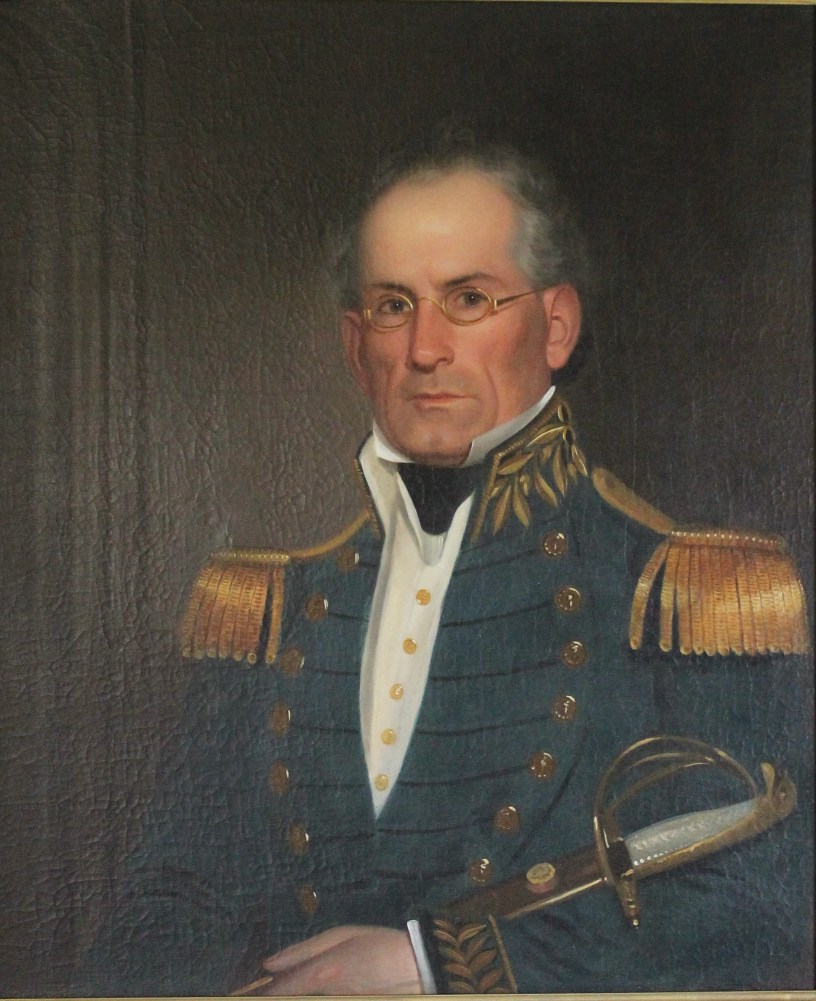
Joel Abbot, Grace’s great-grandfather, had an illustrious career starting with a naval appointment at the age of sixteen. In 1814 the British were coming down Lake Champlain by land and sea, threatening to cut New England off from the rest of the country. With their powerful new warship “Confiance” nearing completion, 21-year old Abbot was asked to sneak behind enemy lines and destroy her spars. His successful mission delayed the British attack, enabling the undermanned Americans time to bring up new warships of their own. In the subsequent “Battle of Lake Champlain” the Americans defeated a superior British force and effectively ended the War of 1812 and Britain’s hopes of regaining control of her rebellious former colonies.
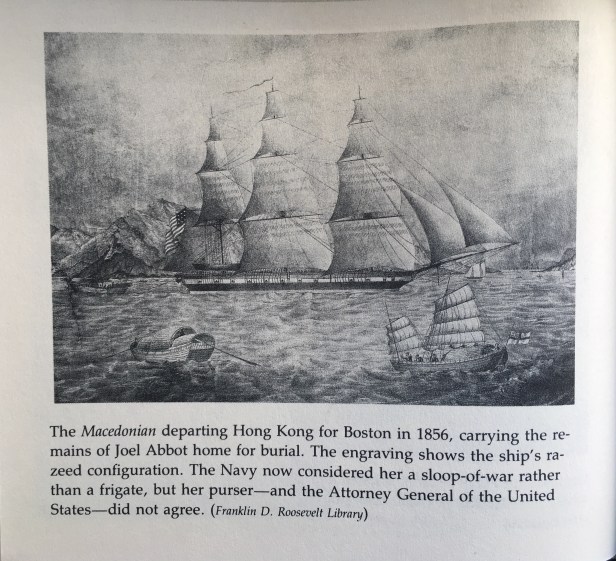
Towards the end of his career Abbot commanded the frigate “Macedonian” as part of Matthew Calbraith Perry’s 1850s “Black Ships” expedition to open Japan to trade. Abbot subsequently took over the East India Squadron prior to his death in Hong Kong.
A number of artifacts from Joel’s life have been passed down through the family, along with more than 20 log books and journals which Grace had planned to use to write a biography. It will take several future blog posts to present details of his career – including a more in-depth look at the Battle of Lake Champlain, excerpts from his log books, and the like. For now, his obituary will serve as an introduction to his Naval career.
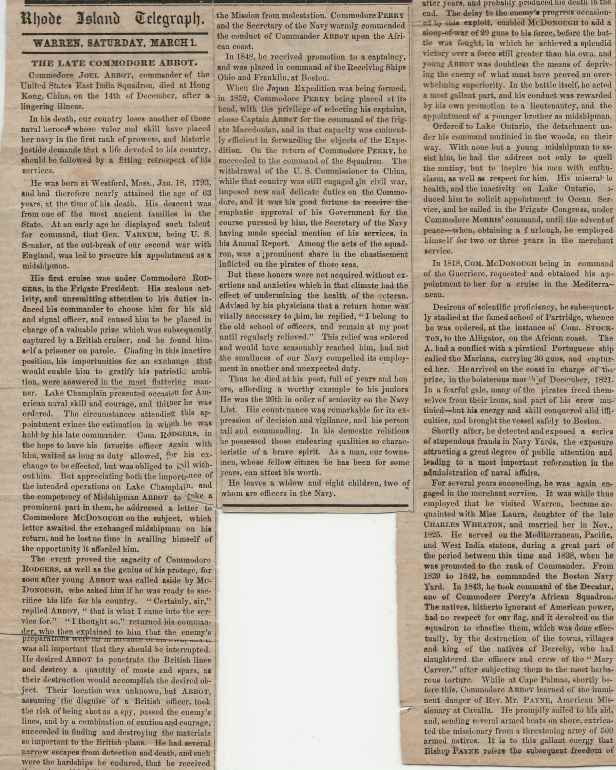
Rhode Island Telegraph, Warren, Saturday, March 1 [1856]
The Late Commodore Abbot
Commodore Joel Abbot, commander of the United States East India Squadron, died at Hong Kong, China, on the 14th of December, after a lingering illness.
In his death, our country loses another of those naval heroes whose valor and skill have placed her navy in the first rank of prowess, and historic justice demands that a life devoted to his country, should be followed by a fitting retrospect of his services.
He was born at Westford, Mass., Jan. 18, 1793, and had therefore nearly attained the age of 63 years, at the time of his death. His descent was from one of the most ancient families in the State. At an early age he displayed such talent for command, that Gen. Varnum, being U.S. Senator, at the out-break of our second war with England, was led to procure his appointment as a midshipman.
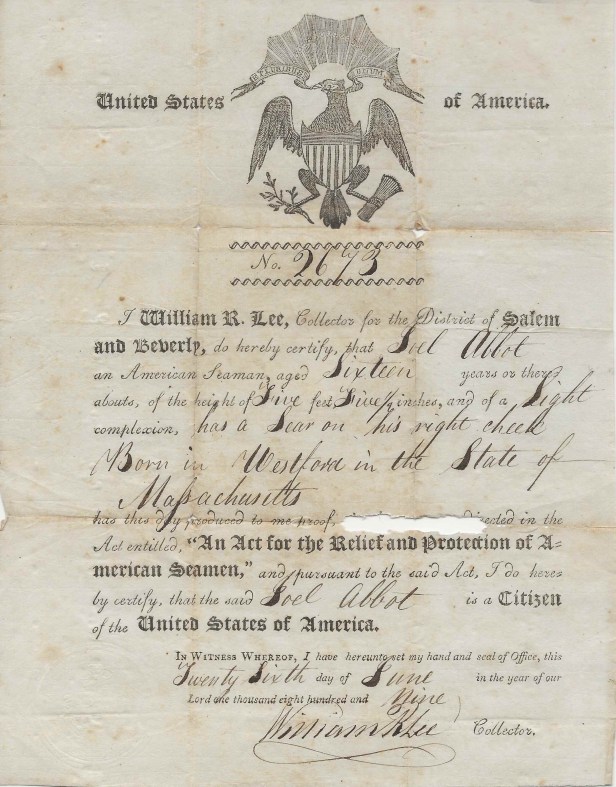
His first cruise was under Commodore Rogers, in the frigate President. His zealous activity, and unremitting attention to his duties induced his commander to choose him for his aid and signal officer, and caused him to be placed in charge of a valuable prize which was subsequently captured by a British cruiser, and he found himself a prisoner on parole. Chafing in this inactive position, his importunities for an exchange that would enable him to gratify his patriotic ambition, were answered in the most flattering manner.
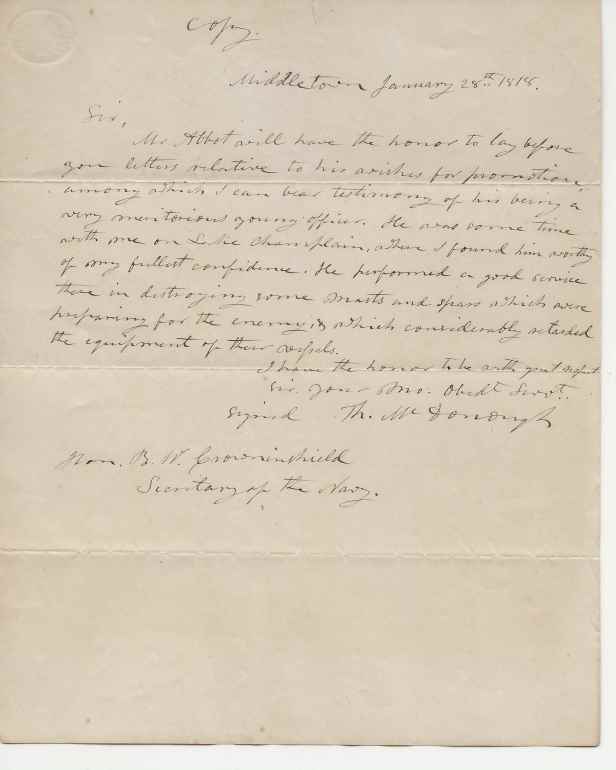
Lake Champlain presented occasion for American naval skill and courage, and thither he was ordered. The circumstances attending this appointment evinced the estimation in which he was held by his late commander. Com. Rogers, in the hope to have his favorite officer again with him, waited as long as duty allowed, for his exchange to be effected, but was obliged to sail without him. But appreciating both the importance of the intended operations on Lake Champlain, and the competency of Midshipman Abbot to take a prominent part in them, he addressed a letter to Commodore McDonough on the subject, which letter awaited the exchanged midshipman on his return, and he lost no time in availing himself of the opportunity it afforded him.
The event proved the sagacity of Commodore Rogers, as well as the genius of his protégé, for soon after young Abbot was called aside by McDonough, who asked him if he was ready to sacrifice his life for his country. “Certainly, sir,” replied Abbot, “that is what I came into the service for.” “I thought so,” returned his commander, who then explained to him that the enemy’s preparations were far in advance of his own, and it was all important that they should be interrupted. He desired Abbot to penetrate the British lines and destroy a quantity of masts and spars, as their destruction would accomplish the desired object. Their location was unknown, but Abbot, assuming the disguise of a British officer, took the risk of being shot as a spy, passed the enemy’s lines, and by a combination of caution and courage, succeeded in finding and destroying the materials so important to the British plans. He had several narrow escapes from detection and death, and such were the hardships he endured, that he received the praises of his delighted commander in a state of exhaustion and disease, that caused returns of it in after years, and probably produced his death in the end.
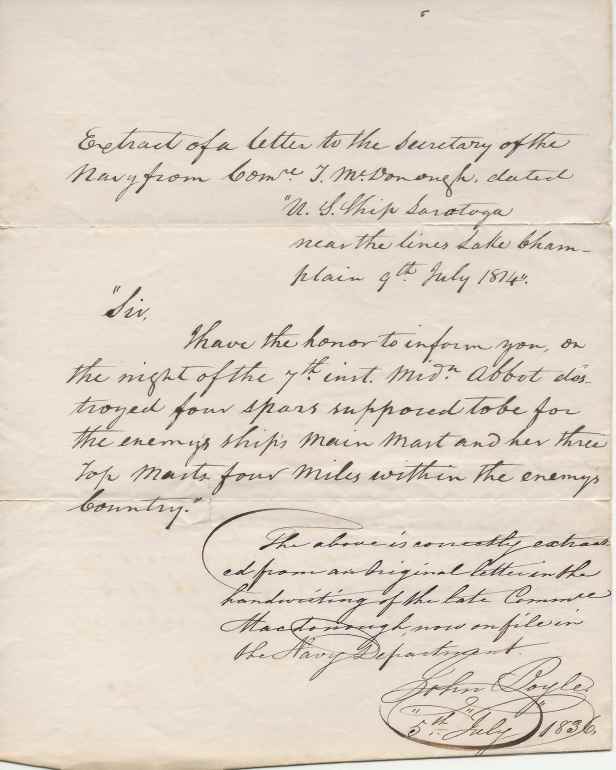
The delay to the enemy’s progress occasioned by this exploit, enabled McDonough to add a sloop-of-war of 20 guns to his force, before the battle was fought, in which he achieved a splendid victory over a force still greater than his own, and young Abbot was doubtless the means of depriving the enemy of what must have proved an overwhelming superiority. In the battle itself, he acted a most gallant part, and his conduct was rewarded by his own promotion to a lieutenancy, and the appointment of a younger brother as midshipman.
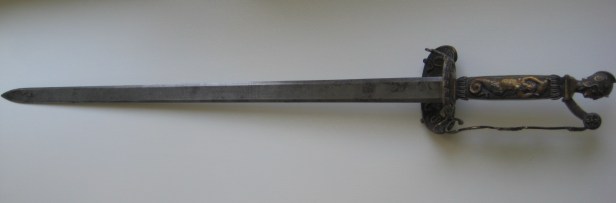
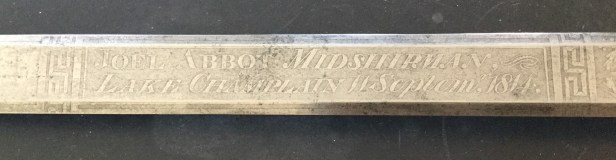
Sword awarded by Congress with the inscription: Joel Abbot, Midshipman, Lake Champlain 11 Septem, 1814. On the reverse is a Latin phrase which translates “They will rise highest who strive for the highest place.” This is one of only eighty swords that the U.S. Congress authorized specifically for the noncommissioned officers who were so important to the victory on Lake Champlain.
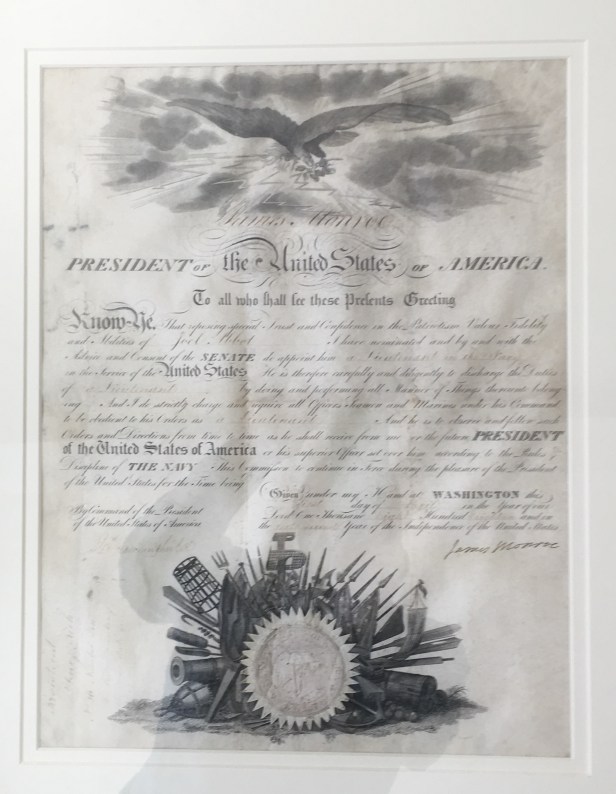
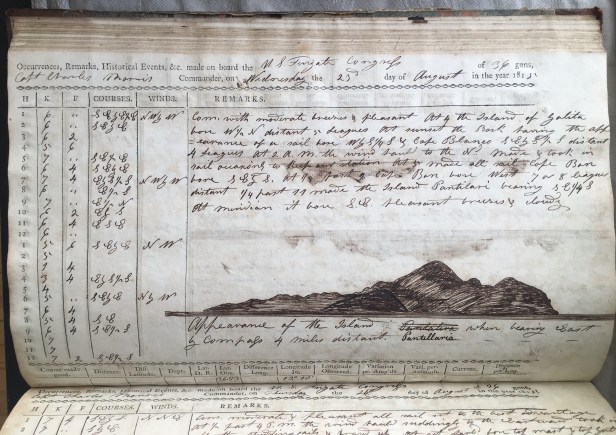
Ordered to Lake Ontario, the detachment under his command mutinied in the woods, on their way. With none but a young midshipman to assist him, he had the address not only to quell the mutiny, but to inspire his men with enthusiasm, as well as respect for him. His miserable health, and the inactivity on Lake Ontario, induced him to solicit appointment to Ocean Service, and he sailed in the Frigate Congress, under Commodore Morris’ command, until the advent of peace – when, obtaining a furlough, he employed himself for two or three years in the merchant service.
In 1818, Com. McDonough being in command of the Guerriere, requested and obtained his appointment to her for a cruise in the Mediterranean.
Desirous of scientific proficiency, he subsequently studied at the famed school of Partridge, whence he was ordered, at the instance of Com. Stockton, to the Alligator, on the African coast. The Alligator had a conflict with a piratical Portuguese ship called the Mariana, carrying 30 guns, and captured her. He arrived on the coast in charge of the prize, in the boisterous month of December, 1821. In a fearful gale, many of the pirates freed themselves from their irons, and part of his crew mutinied – but his energy and skill conquered all difficulties, and brought the vessel safely to Boston.
Shortly after, he detected and exposed a series of stupendous frauds in Navy Yards, the exposure attracting a great deal of public attention and leading to a most important reformation in the administration of naval affairs.
For several years succeeding, he was again engaged in the merchant service. It was while thus employed that he visited Warren, became acquainted with Miss Laura, daughter of the late Charles Wheaton, and married her in Nov., 1825.
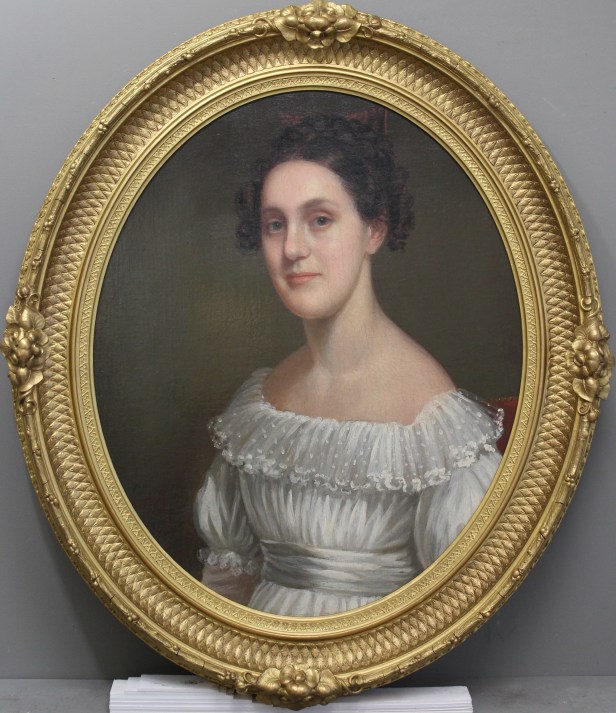
He served on the Mediterranean, Pacific, and West India stations, during a great part of the period between this time and 1838, when he was promoted to the rank of Commander. From 1839 to 1842, he commanded the Boston Navy Yard.
In 1843, he took command of the Decatur, one of Commodore Perry’s African Squadron. The natives, hitherto ignorant of American power, had no respect for our flag, and it devolved on the squadron to chastise them, which was done effectually, by the destruction of the towns, villages and king of the natives of Berreby, who had slaughtered the officers and crew of the Mary Carver, after subjecting them to the most barbarous torture. While at Cape Palmas, shortly before this, Commodore Abbot learned of the imminent danger of Rev. Mr. Payne, American Missionary at Cavalla. He promptly sailed to his aid, and, sending several armed boats on shore, extricated the missionary from a threatening army of 500 armed natives. It is to this gallant energy that Bishop Payne refers the subsequent freedom of the Mission from molestation. Commodore Perry and the Secretary of the Navy warmly commended the conduct of Commander Abbot upon the African Coast.
In 1848, he received promotion to a captaincy and was placed in command of the Receiving Ships Ohio and Franklin, at Boston.
When the Japan Expedition was being formed, in 1852, Commodore Perry being placed at its head, with the privilege of selecting his captains, chose Captain Abbot for the command of the frigate Macedonian, and in that capacity was eminently efficient in forwarding the objects of the Expedition.
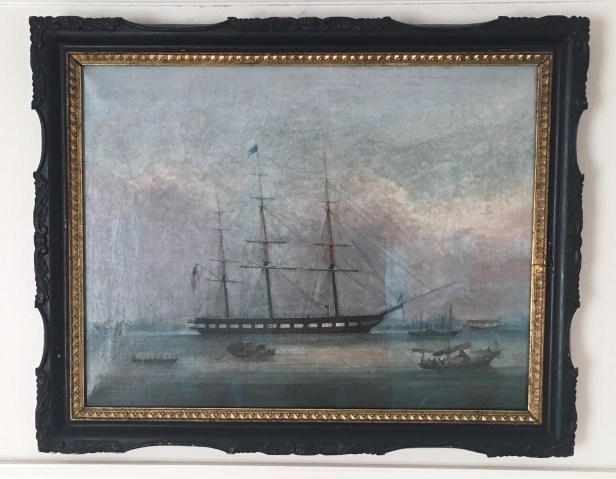
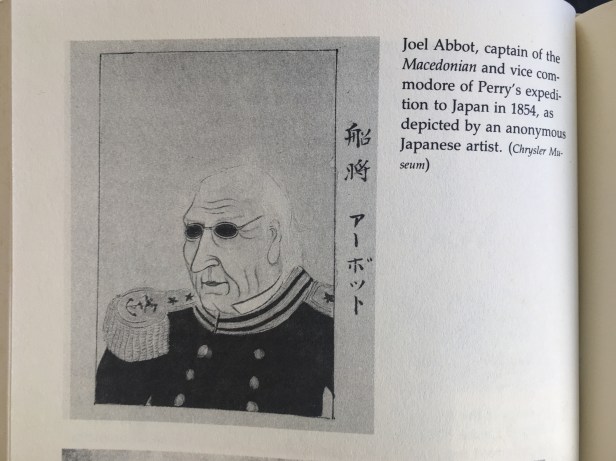
On the return of Commodore Perry, he succeeded to the command of the Squadron. The withdrawal of the U.S. Commissioner to China, while that country was still engaged in civil war, imposed new and delicate duties on the Commodore, and it was his good fortune to receive the emphatic approval of his Government for the course pursued by him, the Secretary of the Navy having made special mention of his services, in his Annual Report. Among the acts of the squadron, was a prominent share in the chastisement inflicted on the pirates of those seas.
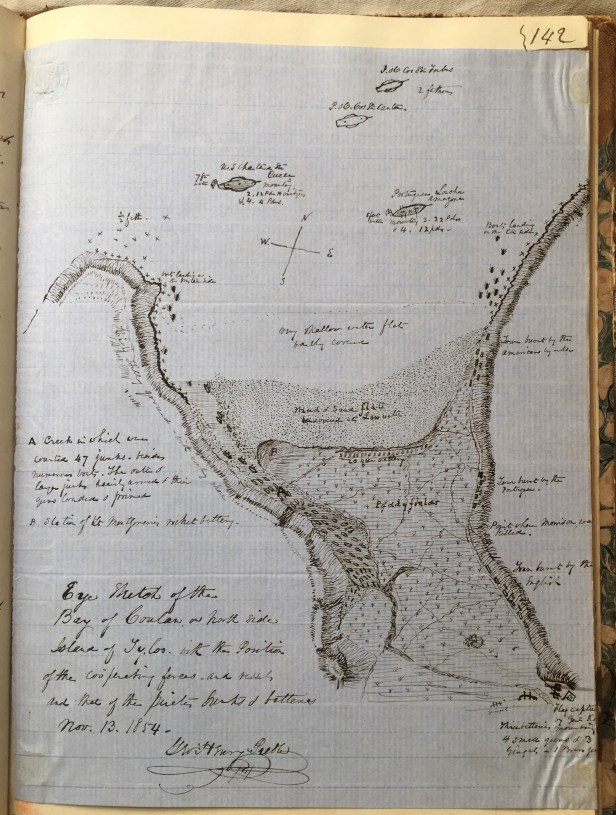
But these honors were not acquired without exertion and anxieties which in that climate had the effect of undermining the health of the veteran. Advised by his physician that a return home was vitally necessary to him, he replied, “I belong to the old school of officers, and remain at my post until regularly relieved.” This relief was ordered and would have seasonably reached him, had not the smallness of our Navy compelled its employment in another and unexpected duty.
Thus he died at his post, full of years and honors, affording a worthy example to his juniors. He was the 26th in order of seniority of the Navy List. His countenance was remarkable for its expression of decision and vigilance, and his person tall and commanding. In his domestic relations he possessed those endearing qualities so characteristic of a brave spirit. As a man, our townsmen, whose fellow citizen he has been for some years, can attest his worth.
He leaves a widow and eight children, two of whom are officers in the Navy.
Addendum:
I’ve often wondered how Joel Abbot was able to find and destroy the masts and spars of the British ship on Lake Champlain. In one of Joel’s log books I found a copy of a letter written by Joel’s son John, dated 1852 (Book #16, pages 98-106) which provides additional detail of this event:
“The services which my Father rendered his country on that lake are but little known at the Navy Department, their lively and grateful remembrance died with Commodore Macdonough who a few days after the battle addressed my Father in these words: “Mr Abbot, the country owes that victory to you, if it had not been for you we should have been sadly beaten.” I rely for confirmation of the most material points of the following brief narrative upon an extract from Commodore Macdonough’s dispatches to Navy Department, also his letter to Secretary Crowninshield recommending my Father for promotion to Lieutenant, and upon the memory of two of those officers now living who survived in the battle, among whom I am perhaps at liberty to name Commodore Smith.
You will recollect that in the battle the American force was much inferior to the enemy, that the battle was a long and bloody one and that the American ships were so much shattered as to be in a sinking condition.A few weeks before the battle, both squadrons were laying almost in sight of each other, but the American sloop Eagle 20 guns was yet on the stocks not launched while the enemy’s frigate Confiance 39 guns needed only masting and rigging to be ready for action, and was equipping with all possible dispatch. It therefore seemed inevitable that the enemy would be ready before us to attack our squadron with such an overwhelming superiority of force as to leave us no chance of success. Hence it was necessary to retard in some way the equipping of the Frigate and Commodore Macdonough conceived the bold design of destroying her masts and spars which lay several miles within the enemy’s lines. The execution of this design he instructed to my Father who though sick and suffering from the effects of the Lake water still kept on duty. He immediately proceeded in command of an armed boat across the lake to the enemy’s bank within hearing of the sentinels, secreted his men, and landing, walked alone over the enemy’s country, representing himself as a British Officer in search of timber to the imminent peril of being suspected and hanged as a spy. After two or three hair breadth escapes when all his courage, skill and self propulsion were required he succeeded in ascertaining the situation of the masts, returned to the boat, rowed by night with muffled oars along the enemy’s banks to the place where the masts were secreted, towed them into the lake, cut them up and returned to the ship after three days absence, so weak and exhausted as to be hoisted on board. The masts were destroyed the very night before they were to be taken to the frigate. Thus the equipping of the British vessel was delayed many days, and in the meantime the Eagle was completed, launched and rigged and the attack of the enemy almost immediately ensued.
It cannot be doubted that but for the destruction of those masts, our squadron would have been destroyed and Plattsburgh attacked both by land and water according to the enemy’s plan. In case of the defeat of our fleet, the enemy designed to fortify the positions of Ticonderoga and Crown Point which would have given them a strong foothold in our country. And as soon as the British General saw that his fleet was captured he made a precipitate retreat. Father however was not in the battle, he had been sent to Boston by Commodore Macdonough upon the important duty of procuring men and the battle took place in his absence. It was on his return that Commodore Macdonough addressed Father in the flattering terms I have repeated. Afterwords when the command of a frigate was given him with the privilege of selecting his officers he named Father as one.” [note: interestingly, this account differs from the Obituary which makes note of his participation in the battle itself. Perhaps more evidence will come to light to clarify this in the future].
 Abbot and Fletcher Family History