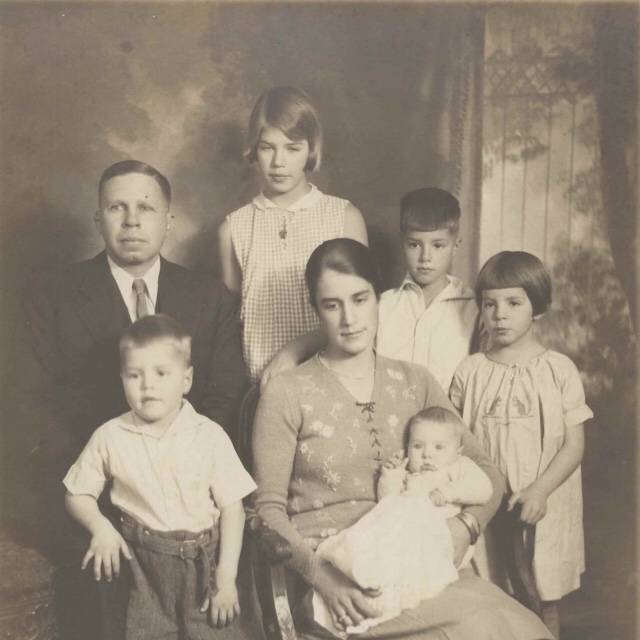
The marriage of Grace Abbot and Paul W. Fletcher in Warren, RI in 1917 joined two old New England families. Growing up, my cousins and I heard tales of daring and bravery, as well as stories of simple and honest folks making their way in a new and fast developing country. Our forebears all contributed to the fabric of the family values that we grew up with.
As I’ve read and researched I’ve come across interesting new stories, or new slants on old ones – intrigues with Queen Elizabeth I, for example, or my great-grandfather’s friendship with a legendary rum-runner, Bill McCoy, to whom he had taught seamanship. Curiosity of the past led to discovering wonderful Norwegian cousins whom we never knew we had, all of us descended from a common 2nd-great grandfather.
Since I’ve gotten older I’ve come to appreciate just how interesting the lives of some of these ancestors really were, and in the value of preserving the record of where we came from. In the coming years I hope to further explore some of their stories and share them here. A brief overview of some of the people whose stories have been passed down, that I hope to explore and expand upon in coming years, are recorded below.
Among the nine Mayflower voyagers Grace was descended from was her 9th-great grandfather, Elder William Brewster, cofounder of the small group of worshippers who started meeting in secret in Scrooby, England in the early 1600s. Brewster would become a spiritual leader of the Pilgrims, and was likely the primary author of the Mayflower Compact, one of the earliest documents setting out the democratic ideal of a “civil Body Politick” for what would become America.
His teenage daughter Patience, left behind in Holland, joined her parents in the New World three years later and married Thomas Prence, who would serve as Governor of Plymouth Colony for many years during its formative period.
Another ancestor, John Howland, fell overboard from the Mayflower during a gale and it was only by chance that he managed to grab onto a piece of rigging and be hauled back aboard. A total of fourteen of Grace’s ancestors came over in the ships Mayflower (1620), Fortune (1621), Anne (1623) and Little James (1623), whose passengers are referred to as “First Comers” in early Plymouth records. Between the Abbots and Fletchers, another sixty or more came over prior to 1640 in the “Great Migration.”
The long-standing tavern in Plymouth Colony was founded by Grace’s 7th great grandfather, James Cole, on what is now Cole’s Hill in front of Plymouth Rock overlooking the harbor. The tavern developed a rather rowdy reputation – in stark contrast to the churchgoing community – almost reminiscent of those taverns which gave the American West a notorious flavor. Around the same time, Reverend George Phillips came with Winthrop’s fleet in 1630 and founded the first Congregational Church in what is now Watertown, MA. He was more tolerant than some of his compatriots and encouraged inclusiveness in the Church.
The founders of Concord, Massachusetts in the 1630s included Robert Fletcher, George Wheeler and Joseph Merriam on the Fletcher side of the family. Their offspring would be involved in the “shot heard ’round the world” more than a century later. Ebenezer Fletcher from New Hampshire served in the Revolutionary War. Wounded and captured by Burgoyne’s forces near Ticonderoga, New York, he escaped and made his way back home through territory controlled by the enemy. His published account of his weeks-long ordeal is a compelling story. Benjamin Williams, also on the Fletcher side of the family, was an orderly Sergeant at the Battle of Bunker Hill, and also fought at Bennington and Stillwater. I recently discovered family records that indicate his mother was from the Scottish Munroe clan, descended from William Munroe, a soldier taken prisoner at the 1651 Battle of Worcester (England) after Oliver Cromwell defeated Charles II’s Loyalist forces. Cromwell dispersed many of the prisoners to the New World. Munroe was sent to Lexington, Mass as an indentured servant.
General Nathan Miller, Grace’s 3rd-great grandfather, was a delegate at the 1786 Continental Congress and Brigadier General for Rhode Island in the Revolutionary War. He had a warm friendship with Count Rochambeau, and family lore recalls that Rochambeau, George Washington and the Marquis de Lafayette were all entertained in Miller’s home in Warren. When the British attacked Rhode Island in 1778 they came after General Miller, who was carrying valuable state papers. He escaped with his wife and daughter by rowing across the river to Barrington, during which a British bullet whizzed through his daughter’s hair – another margin by which the family lineage survived. In the subsequent Battle of Rhode Island, Miller led the American forces in what LaFayette would pronounce “the best fought action of the war.” General Miller’s home in Warren, R.I. would become a family homestead and remained in the Miller and Abbot families until the 1950s.
At age 21 Joel Abbot, Grace’s grandfather, was asked by Commodore Thomas Macdonough to sneak behind enemy lines on Lake Champlain and destroy the spars for Britain’s powerful new frigate Confiance. His successful mission, for which Congress awarded him a sword, delayed the British attack and enabled the under-manned Americans to reinforce their fleet. Their ensuing victory at Plattsburgh Bay on September 11, 1814 prevented the British from marching to New York and severing New England from the rest of the country. Later in his career Commodore Abbot would captain the USS Macedonian as 2nd in Command on the 1850s expedition to Japan under Matthew Perry and took charge of the fleet after Perry’s departure. Two US Navy ships were named for Joel Abbot, including the destroyer USS Abbot (DD 629) which Grace christened at its 1943 launching at Maine’s Bath Iron Works.
During the Civil War the Union wanted to close down the Mississippi from Confederate shipping and transport. Grace’s grandfather, George Marcellus Ransom commanded the steam gunboat Kineo and participated with Farragut’s fleet in several memorable battles. While forcing their way past New Orlean’s forts the Kineo was set on fire by a red-hot shot. Ransom is credited with coolness and alacrity in saving the ship and participating in the capture of New Orleans, and later played a key role in defeating Breckinridge at Baton Rouge.
Paul Fletcher’s great-grandmother Malena Rasmusdatter grew up on the small island of Midbrod on Norway’s southwest coast. In 1811, during the Napoleonic War, the Norwegians captured a British ship full of valuable rope and tar and hid it in a small cove on the north side of Midbrod. The waters were too narrow to bring in their warship, so the British sent an armed expedition of small boats to rescue the ship. The local men were out fishing, but Malena rallied the local woman and boys and fought off the attackers, garnering her a cover photo as a sort of “Joan of Arc” in a recent Norwegian history magazine.
Malena’s son Peter Christian Asserson left Midbrod as a teen and made his way to the US where he became one of the few foreign-born sailors to attain the rank of Rear Admiral. He commanded various ships during the Civil War, and after the war was in charge of removing war time obstructions including the famous gunboat Merrimack. He also raised the Delaware and donated its figurehead, portraying the Indian chief Tecumseh, to the USNA where it became a prominent feature on campus. Asserson’s biggest contributions came after the war, when he introduced concepts that transformed the efficiency of US shipyards.
Asserson’s daughter Malene married William B. Fletcher, who would himself become a Rear Admiral and led a fleet of converted sailing yachts in the Atlantic during WWI. Fletcher’s sons served with distinction, including Rear Admiral William B. Fletcher, Jr. who commanded ships at the battles of Midway and at Guadalcanal, and John A. and Paul W. Fletcher, both of whom died while on active duty.
The Fletcher and Abbot families were active in other fields, some more savory than others. Joseph Smith of Warren, RI, lost money on his first whaling voyage, but made money on the second. He would eventually have 23 ships at sea. The Abbot Family helped found the town of Andover and the prestigious schools located there. One of the family patriarch, Benjamin Abbot, testified against Martha Carrier at the witch trial for which she would be hanged, claiming she had infected his leg. Shipowner Caleb Eddy undertook a voyage for slaves in 1795 with mixed results.
The families continue to make contributions, and sacrifices, to our country. John A. Fletcher Jr., 4-year captain of the USNA wrestling team and a member of the 1948 and 1952 US Olympic teams, was lost in 1953 flying a Navy plane off Norfolk. In 1968 Peter Fletcher lost his life while serving in Vietnam.
We owe the late Abbot Fletcher, Grace’s son and himself a truly remarkable person, a great debt for preserving many of these stories and associated documents and for assembling the roots of the family tree upon which this effort builds. In his Eulogy to his mother, Abbot described the New England heritage of which his parents came: “These families were for the most part deeply founded in and participants in the Puritan work ethic of hard work, service to God, strong family ties, free enterprise, patriotism and the independence and strength that alone retain freedom.”
It is my goal to record and preserve some of these interesting stories, and to uncover more, for the benefit of future generations and other interested parties. This blog will be a work in process over the coming years as opportunity allows. I welcome comment, support, and additions.
 Abbot and Fletcher Family History
Fascinating to read. Since you are open to suggestions, I would suggest simply add the specific year, 1953, of my father’s death, which shows that he died for his country during war time, the Korean War. Also, he was actually a two-time Olympic wrestler, 1948 and 1952. (Gram and Aunt Kristin took a ship to Finland to watch him wrestle.) One other small detail: he was piloting a plane, not a jet. Jets came along a little later, I believe. You put a lot of hard work into this, and it shows. Gram would be very pleased, indeed. She was an aspiring writer and traveled around New England to go to meetings of her writers’ group. Her hope was to create a book on Joel Abbot. I think his logs, her notes, etc, may have been donated to a museum or library. Thanks for including both Johnny and Peter! Melissa Fletcher
LikeLike
Max, you have done the whole family a wonderful service in pulling together so much information regarding our shared history, and making it readable, too. Even those of us who are not Abbotts can appreciate the sweep of American history encompassed by your reference to specific details in so many ancestors’ lives. Weaving all those threads together results in quite a tapestry… and a realistic appreciation for the lives of those who have gone before us. Susanna
LikeLike
Thank you, Susanna – and thank you for your great bio of Peter Christian Asserson, and your interest and support with Grandpa’s (WB Fletcher) journals. Hopefully our efforts will be useful to those in future generations who may be interested.
LikeLike
Thought you might be interested in this.My parents lived across the street from “Ma Fletcher” in Warren and when I was going through my mother’s things there was a Christmas postcard. An Ink drawing not sure might have been done by her.
LikeLike
Hi Elin, if it’s easy to send a picture or scan it would be fun to see, Grace used to send out personalized Christmas cards. Thank you for your note and interest. Max.
maxwellabbotfletcher@gmail.com
LikeLike
I have been researching the G M Ransom side of the family for about 20 years; especially Cmdr Ransom’s and Dr. George Manley Ransom on their 1870 voyage on the Terror (Key West and Havana).
LikeLike
Hi John, I hope to do a post about Cmdr Ransom at some point. I am in Spain just about to sail my boat back to Maine but will touch base later in the summer. Thank you for your comment. Max
LikeLike
Max, Thanks. I’ve been to the graveside in New York. to Norwich and drove by the address ascribed to the Cmdr. Earlier in my life sailed (as ballast) on 17′ TownClass on RI rivers and bays. But spent some time trying to find his family connections to flesh out who he was. The glimpses of G Marcellus Ransom as CW hero in the Official Documents f the War (even if he was on the other side) are remarkable. A Farragut loyalist I believe and the newspaper and other glimpses of him during Farragut’s last gasp at the Peabody funeral in Portland (Me) and later in key West and Havana (the only voyage of the Terror) I try to “see” through the eyes of my Virginia Private, former CSA cavalry, and at least as far as I can determine the only former rebel (?) on the Terror. So much about the monitor and only snippets of its captain, Ransom. So I wanted to know more. that lead me to Grace, Manley and the other accomplished or flawed children.
LikeLike
Ted Swift
Hello Max, I worked with Susanna several years ago on the Peter Asserson bio and am a Great Great Grandson of George Marcellus Ransom. Today I did an AI search on him and was puzzled to read in the third paragraph that he was NOT the same George Ransom who commanded the USS Kineo. I found that quite puzzling, did not think it was well documented, and likely not credible. The search is below and I’m curious as to your thoughts. AI can be great but is certainly not infallible.
https://www.perplexity.ai/search/describe-in-detail-the-life-an-CVIo602NRL.CwXrKFFulVQ
LikeLike
Ted
I would have to dig deep in my notes, but I am not convinced that Ai got it right. I have the volume of the war documents re the Mississippi River battles and I think Ransom is one in the same. (But as all researchers know, I can make mistakes faster than Ai.
John
LikeLike
Hi Ted, Thank you for your note, and your prior help with the PCA biography. As to your question, it must be a glitch with AI. There is no doubt our ancestor GMR was commander of the Kineo. I have a 4-page tribute given by the NY Military Legion upon his death in Norwich, CT describing in detail his military career and actions aboard the Kineo. I also have a typed summary of his naval career, and letters he wrote his wife while aboard the USS Narragansett which immediately preceded his Command of the Kineo. These were amongst family papers from the old Miller-Abbot homestead in Warren, RI. I’d be happy to send copies to you if send me your email. (My email is on the blog: my full name @ gmail. I should add a blog entry for GMR on my site. Let me know if you’d like to participate in writing something up. Thanks again for your note. Max
LikeLike
Max, it’s all fascinating stuff. I came across the following reference to George Marcellus Ransom…
https://findingaids.lib.umich.edu/catalog/umich-wcl-M-2554ran
This was donated to the University of Michigan in 1990 by Helen Virginia Harris (nee Swift) half-sister of my father Garfield Swift. Their paternal grandfather was Admiral William Swift. who married Grace Virginia Ransom, daughter of George Marcellus Ransom. (My Dad’s mother, Agnes Asserson Swift, died giving birth to him in 1908}.
In his early years, until about age 15, my Dad was raised not by his father, Justin Swift, but by Admiral William B. Fletcher, Sr and his wife, Malene Asserson Fletcher. It’s a long story folks.
Admiral William Fletcher, Jr., was for all practical purposes my dad’s older “brother.” Their daughter, Mary Louisa, was, for all practical purposes, his older sister. So he was more a Fletcher than a Swift. I knew Bill Fletcher Jr as “Cousin Bill” and attended his funeral in 1980 at Arlington Cemetery. After Malene Fletcher’s untimely death, my Dad was reunited with his father, Justin, in Illinois (more long story. But enough of that).
I think it’s pretty clear, Max, that George Marcellus Ransom commanded the USS Kineo and that the information in the AI search result was wrong. Wonder how it got there.
Ted
LikeLike
Ted Swift
The following purports to show Commodore George Marcellus Ransom’s career promotions:
George Marcellus Ransom
RANSOM, George Marcellus, naval officer, born in Springfield, Otsego County, New York, 18 January, 1820. He was educated in the common schools of New York and Ohio, entered the navy as a midshipman on 25 July, 1839, studied at tile naval school in Philadelphia, became a passed midshipman on 2 July, 1845, a master on 28 June, 1853, and a lieutenant on 21 February, 1854. He served on the coast of Africa in 1856-‘7, was commissioned lieutenant-commander on 16 July, 1862, and, in command of the steam gun-boat “Kineo,” of the Western Gulf blockading squadron, had several engagements with the enemy in March and April, 1862. He passed the forts Jackson and St. Philip in Farragut’s fleet, engaged the ram “Manassas.” and in May, 1862, a field-battery at Grand Gulf. He performed effective service in shelling General John C. Breckinridge’s army at Baton Rouge, 5 August, 1862, and engaged a battery and a force of guerillas on 4 October He was promoted commander on 2 January, 1863, and served with the North Atlantic blockading squadron in command of the steamer “Grand Gulf” in 1864, and captured three steamers off Wilmington He was commissioned captain on 2 March, 1870, and commodore on 28 March, 1877, and was retired, 18 June, 1882.
Edited Appletons Encyclopedia, Copyright © 2001 VirtualologyTM
LikeLike
Hi Ted,
I assumed you were related to Garfield Swift but didn’t realize he was your father. I’ve enjoyed listening to some of his remarkable opera songs on YouTube. I’m sure I met Garfield as a kid, because we summered next to Aunt Louisa (formerly “Grandpa’s” ie WM B Fletcher Sr) house on Orr’s Island where Garfield would have spent summers. I ended up with that house upon Aunt Louis’s death in 1980 and have lived there ever since.
If you haven’t seen it yet, check out my blog on “Our Norwegian Cousins.” The summer of 2015 I was sailing along the Norwegian coast and visited PC Asserson’s birth town and found our long lost cousins, wonderful folks. Susanna has met them when they came to the US.
Max
LikeLike
Hi Max,
Yes, I’m the oldest son. I know you have met my brothers Bill and Judd. Bill turned 70 last July and Judd will be 80 next May. Time flies.
I’m the one who put the music up on YouTube. Wish the quality of the recordings had been better. You lose something (a lot) in the MP3 format. The songs from Show Boat etc were recorded at a studio in New York City in 1946. My parents hired backup musicians from the Andre Kostelanetz orchestra and members of the Fred Waring Pennsylvanians.
I wonder if you can help me with the pronunciation of “Malene.” Should have asked Susanna. Was it “MAY-lene?”
Lets stay in touch. I moved from Maryland to San Diego three years ago. My wife, Nancy, is in memory care in Torrey Pines with advanced Alzheimer’s. Going to grab some breakfast now and go visit her as I do every day.
Take care,
Ted
LikeLike
I’m sorry to hear about your wife, Ted. That is such a difficult disease, and unfair to all involved.
I’ve always used the pronunciation “Ma-Lean” but don’t know if that’s correct. I think I would have remembered if the Norwegian cousins had pronounced it differently.
All the best,
Max
LikeLike
Ted Swift
Thank you Max.
Today I challenged the Perplexity AI results about Commodore Ransom and USS Kineo. As a result they have revised their findings to show that he in fact DID command Kineo in 1862. See following:
https://www.perplexity.ai/search/what-challenges-did-ransom-fac-97.F04TGSe.teDsLGAEQRA
His career certainly accelerated after those battles under Admiral Farragut on the Mississippi!
LikeLike
Hi Ted, FYI there are portraits of Bill Swift, the Ransom family and others on the blog titled “Abbot, Manley and Ransom portraits.” The portraits were in 2 albums that presumably came from the Miller homestead in Warren, RI. I recently corrected the url to the photo album so hopefully it works now. Max
LikeLike